The right front door decorations for christmas run from a twelve-dollar brass hoop wreath to a full surround pushing $300, and the deciding factor is whether you rent or own. Renters face the same cold rain and weight limits every December, so the pieces that survive are the ones that come down in ten minutes with no drill and store in a shoebox. A 24-inch faux wreath with a lightweight foam core hangs on an adhesive hook rated above five pounds, and a battery pack tucked behind the bow keeps the cord invisible from the street.
1. Traditional Wreaths
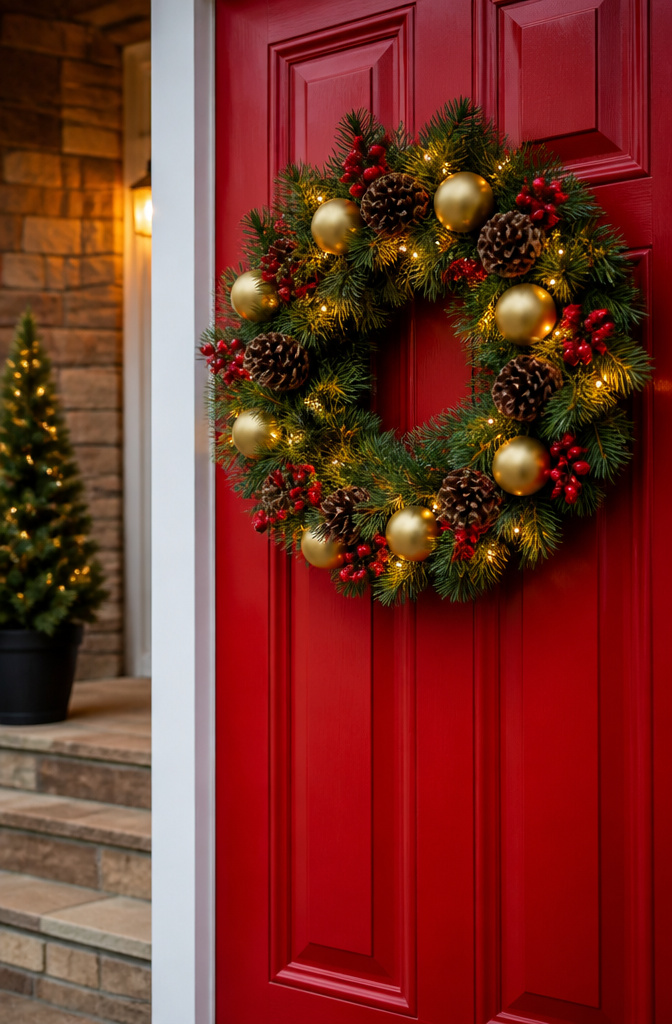
A fresh evergreen wreath still reads as Christmas the moment someone walks up the driveway, but the upkeep separates the committed from the realistic. Real greenery needs misting every few days in dry climates and starts dropping needles by week two; faux versions from craft stores run about half the cost over a five-year span and hold up against rain without turning brown. I have leaned toward faux for rental doors with no overhang, where direct exposure kills a real wreath before New Year’s.
Theming a basic circle takes almost no extra time. A wired ribbon looped through the frame at 10 and 2 o’clock gives structure, and clusters of matte ornaments wired to the inner edge catch light without reading as department-store display. Pinecones and red berries bridge natural and traditional looks, and they work on either real or artificial bases. Warm white lights woven through the greenery, not draped over it, keep the silhouette intact after dark.
For renters watching weight limits, a 24-inch faux wreath with a lightweight foam core hangs safely on most adhesive hooks rated above five pounds. Skip the grapevine bases if your door faces full afternoon sun; they dry out and shed worse than real fir. A battery pack tucked behind the bow, not below it, keeps the cord invisible from the street.
2. Festive Garlands
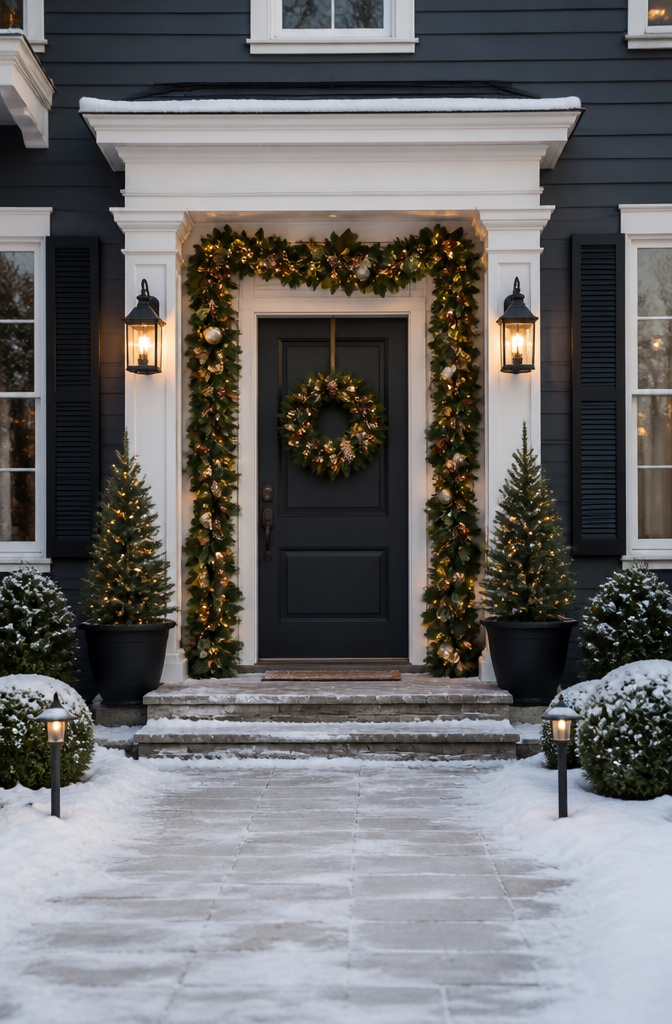
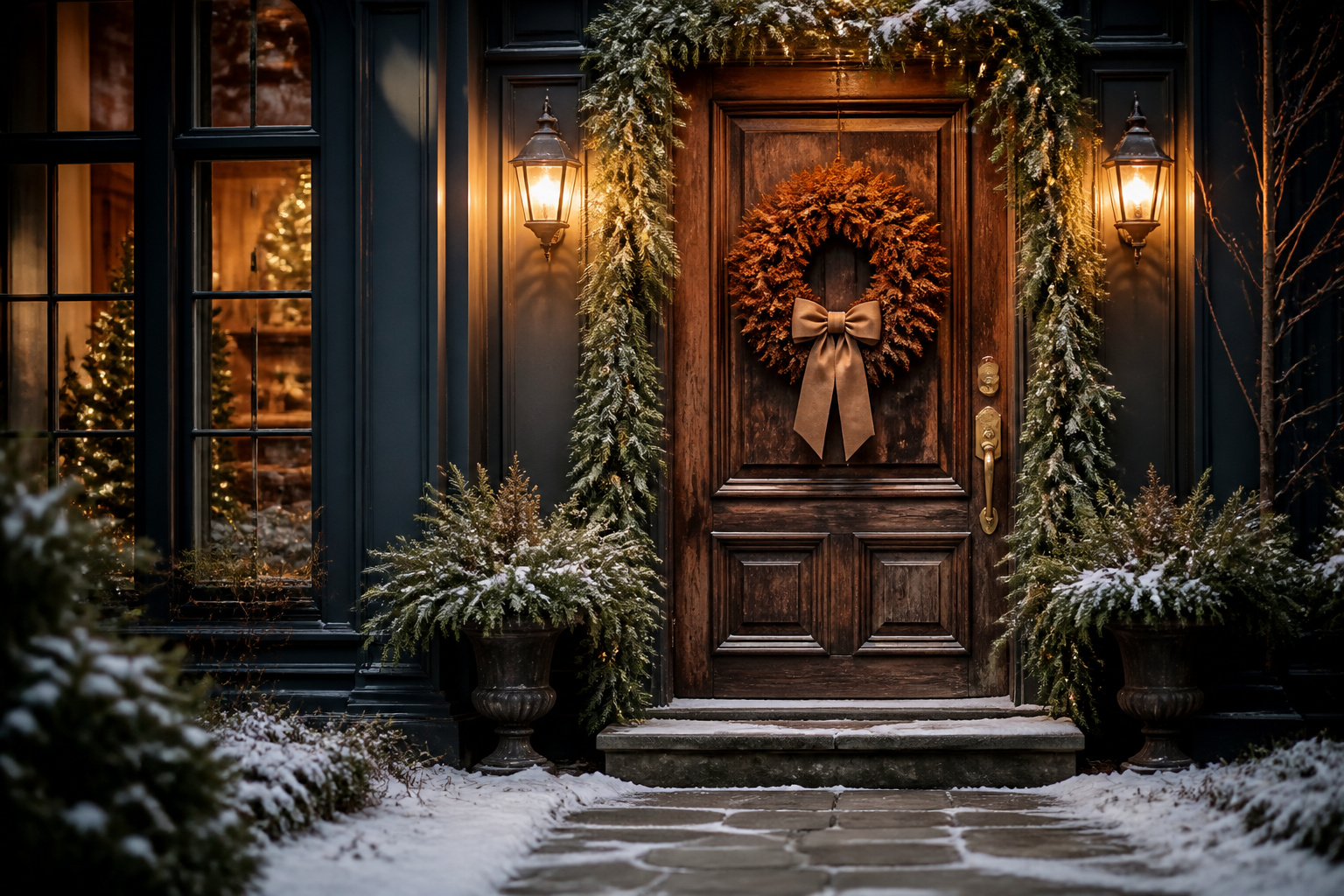
A garland hung around a door frame does more than fill space; it redefines the architecture for about six weeks. The Classic Evergreen Front Door Garland works with almost any house style, and layering it with a matching wreath on the door itself turns a flat facade into something that reads intentional from the street.
Evergreen is the starting point most people picture, though magnolia leaf garland is the quieter upgrade that holds up longer in dry winter air. Designer Miles Redd used it on a 1920s Georgian brick house to emphasize the stone frame around the door, then tied the look together with a matching wreath. The pairing of garland plus wreath is worth copying even on a rental: neither piece requires hardware that leaves marks, and both come down in January without a trace.
Faux options have improved enough that the Original Afloral Real Touch Norfolk Pine Garland, at 60 inches, passes for the real thing across a doorway. Add battery lights or tuck in a few red ball ornaments if the greenery alone feels too plain. The mistake I watch people make is sizing too skimpy; a thin line of garland looks apologetic, while one thick enough to catch shadow reads lush.
3. Oversized Bows
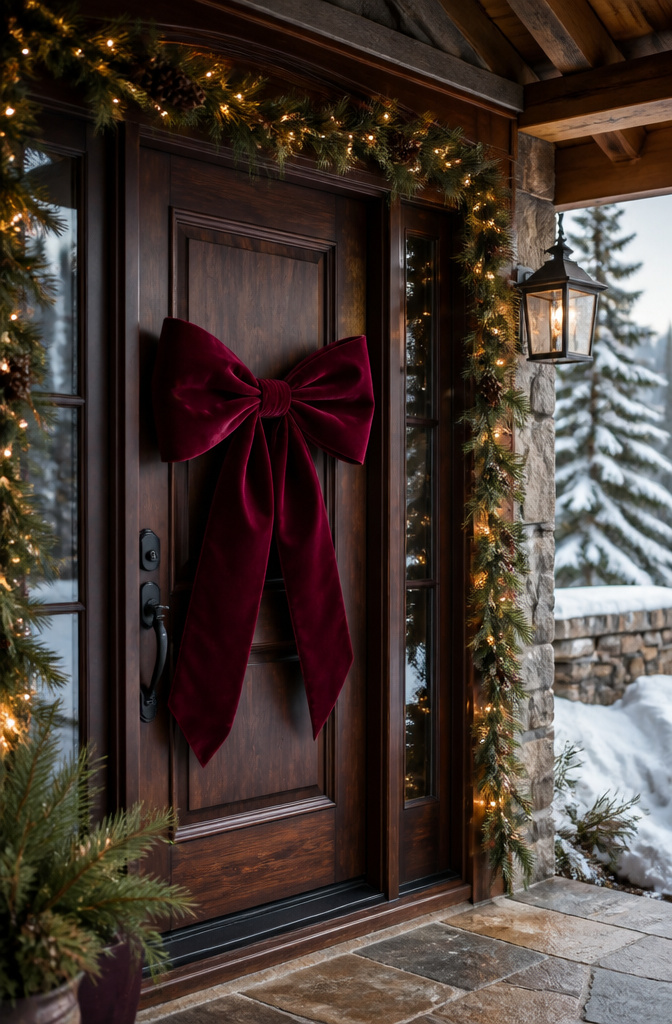
A single oversized bow tied dead-center on a door reads like a present the house is giving the neighborhood. The scale matters more than the pattern: a bow much under 18 inches across disappears on a standard 36-inch residential door, while something in the 24- to 30-inch range holds its own from the curb. Ribbon weight is the detail that separates the look from a gift-wrapping afterthought. Velvet or wired canvas ribbon keeps the loops open and the tails hanging straight through freeze-thaw cycles; lightweight satin collapses on itself by New Year’s.
For renters wary of nail holes, a wreath hanger flipped backward gives the bow a hook without touching the door face, or the bow can anchor directly to a wreath as its only accent. The oversized wreath statement door builds from the same logic: a big wreath with mixed greenery, pinecones, and a velvet bow becomes the focal point, then the bow either echoes it on the knocker or replaces the wreath entirely. Two ways to play this: one massive bow as the whole decoration, or a slightly smaller bow paired with garland framing the frame. The solo bow wins for a weekend project under $50 and zero ladder work; the garland pairing needs more material and more attachment points but reads more finished from twenty feet away.
4. Lanterns and Light
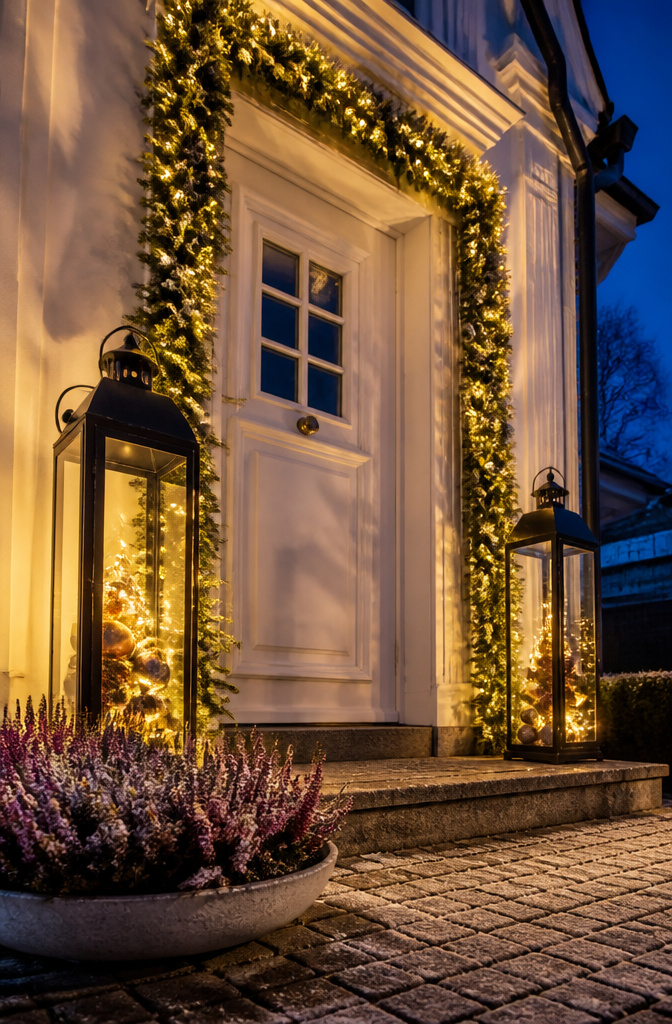
Lanterns flanking a doorway give light at the exact height where guests need it, and the fill inside matters more than the shell. Tall lanterns on each side of the door, filled with a strand of fairy lights and layered with mini ornaments, greenery, or pinecones, glow in three dimensions instead of reading flat from the street. The Govee Christmas String Lights work for this, or for wrapping a wreath, railing, garland, or the small tree by the door in the same connected setup. A single strand of smart lights can transform your entire entryway, shifting color without the tangle of extension cords running to each separate piece.
For renters, the power source is the real decision. Battery sets hide anywhere and move with you, but expect to swap or recharge them through the season. Plug-in strands give steady brightness if your door has an outlet within reach. Solar sounds ideal until December days cut the charge short; most renters in apartments with shaded stoops find them dim by 6 PM. My choice for a rental you might leave in two years: start with battery fairy lights inside the lanterns, and add plug-in smart strands only where the outlet already sits.
5. Themed Decorations
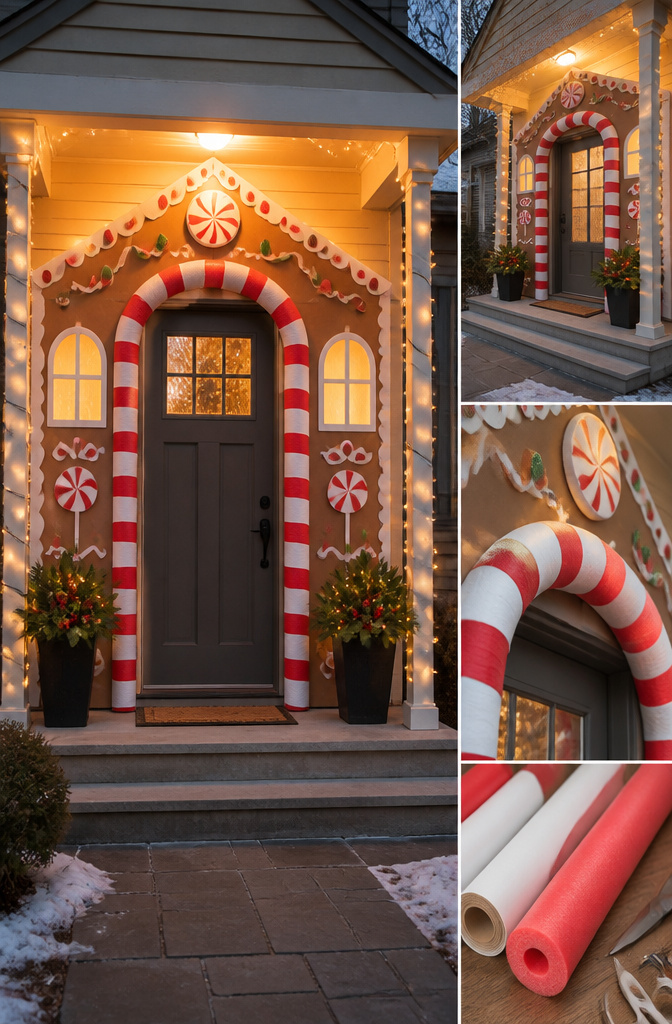
Brown craft paper, white trim cutouts, and candy-colored accents turn an ordinary entry into a gingerbread house door theme that stops sidewalk traffic without stopping your budget. The materials run cheap because the charm lives in the cut-paper details, not in bought objects.
A candycane front door arch works the same way: pool noodles or cardboard tubes, red and white wrapping, and a frame that attaches to the door rather than the siding. Renters get the full effect without a single hole in stucco or brick.
The mistake most people make with themed Christmas front door decorations is buying the theme instead of building it. One inflatable nutcracker soldier becomes three, then a matching mat, then a banner, and suddenly the door is crowded and the wallet is empty. Pick two anchor pieces. For the gingerbread look, that is the paper facade and one oversized candy prop. For soldiers, one figure at the door and a row of smaller wooden cutouts along the step. Everything else is paint and paper you already own.
Family appeal comes from scale. Kids do not care about precision; they care that the door looks edible or that a four-foot soldier guards it. What matters is committing to the single idea. A half-finished gingerbread door reads as brown paper and tape. A finished one, even simply finished, reads as magic.
6. Minimalist Designs
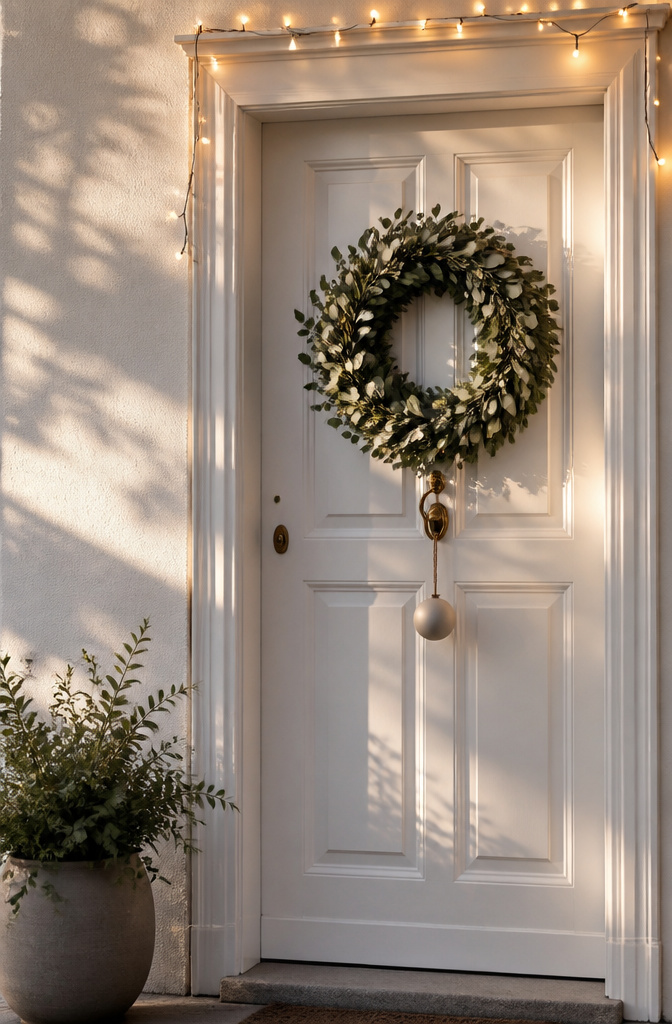
Scandinavian minimalism has dominated the last few holiday seasons for good reason. The look strips away plastic glitter and oversized inflatables in favor of a few well-chosen pieces: a simple wreath of real fir or eucalyptus, a strand or two of warm white lights, and perhaps one matte ceramic ornament hung from the knocker. Restraint reads as intentional when the materials are good; a single branch of fresh greenery in a cast-iron hook carries more weight than a door buried in tinsel.
The practical upside matters as much as the aesthetic. Most renters in apartments or small starter homes do not have a basement to fill with seasonal bins. A minimalist setup stores in one shoebox: the lights coiled, the wreath flattened, the ornament wrapped in a dish towel. I have watched friends abandon elaborate door schemes mid-January because the teardown and storage felt like a second job. A pared-back approach flips that math. The whole install takes twenty minutes, the whole removal takes five, and the box slides onto an ordinary closet shelf until next year.
Warm white rather than cool white is the detail that keeps the look from feeling sterile. The temperature difference is small on the package, but outside after dark it reads as candlelight rather than parking-lot flood. Matte finishes on any metal or ceramic pieces push the same direction, absorbing light instead of throwing it back at the neighbor’s windows. The result feels lived-in, not catalog-perfect, which is exactly the point of a front door that actually belongs to someone.
7. Color-Coordinated Displays
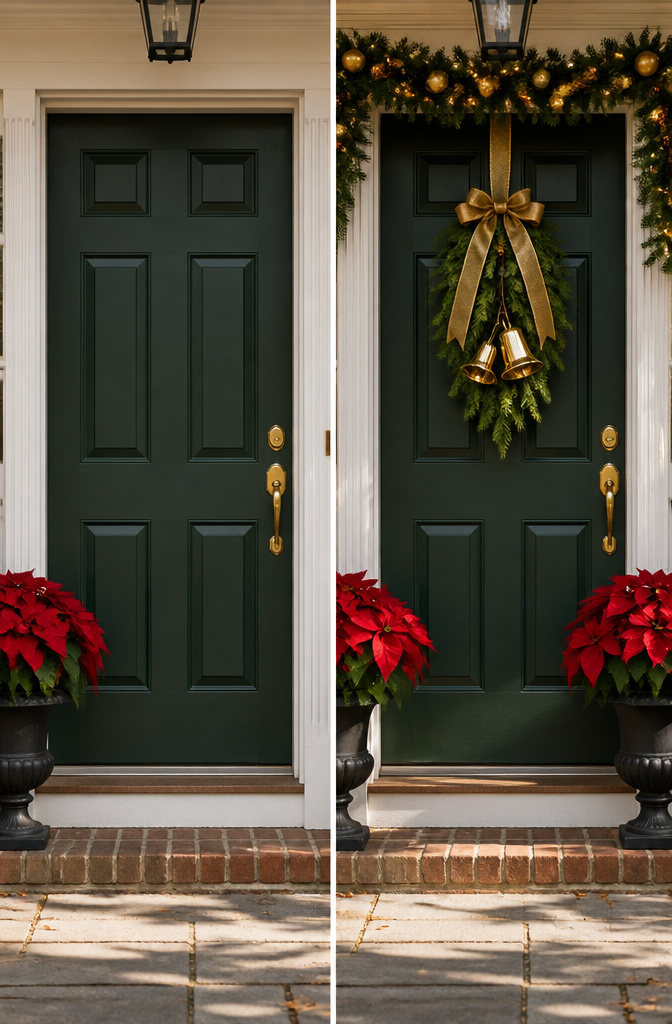
A red door already reads as festive, so gold ribbon or brass bells feel intentional rather than cluttered. Navy paint leans formal; silver garland or white lights keep that mood without fighting it. The question is whether you are building around what you own or starting fresh.
Most renters inherit a door color they cannot change. My last apartment had a faded forest green that swallowed red decorations whole. Working with it meant borrowing from the surrounding trim: cream bows and warm white bulbs picked up the porch railings and made the door look deliberate. The cheapest cohesion comes from matching the hardware you already have, not repainting or buying a full new set.
If you are buying, limit yourself to two finishes. A red door with gold and copper mixed reads muddy; gold alone, even in cheap plastic, reads planned. Same for navy: choose silver or pewter and stay there. Black doors are the exception. Almost anything works, which sounds forgiving but actually makes decisions harder. In that case, look at the siding or the shutters and echo that tone instead.
8. Indoor Porch Decor
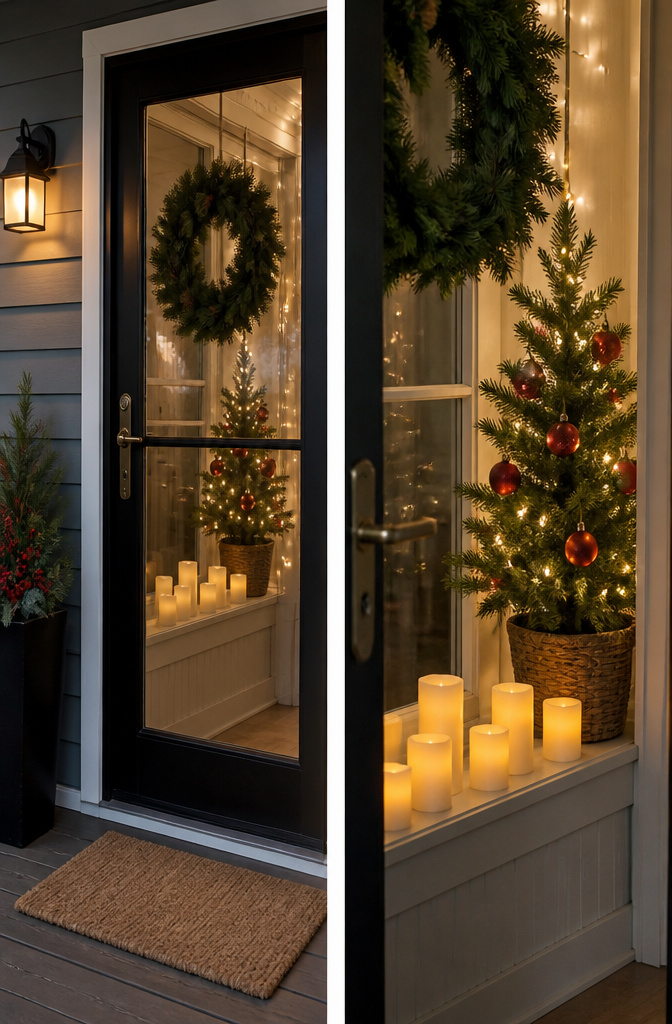
The inner porch is where most renters actually live with their Christmas display, since the threshold itself stays untouched. Glass doors turn this zone into a stage that reads from both sides, so the trick is layering pieces that hold up to backward viewing. A small Christmas tree placed just inside the doorway, paired with a wreath on the inner frame and a line of candles on the sill, gives depth without demanding exterior hooks or drilled holes. Poinsettias grouped on the floor add the red hit that scans as festive from the street even through glare, and they move back to the living room after the season with no patching required.
Lanterns bridge the gap cleanly. The Walker Black Metal Outdoor Lantern at 17.75 inches, set just inside the glass with matching greenery outside, creates the doubled effect that makes the entry feel like a single designed moment rather than two separate attempts. The renter’s rule: nothing permanent on the exterior, everything visible from it. Candles inside those lanterns should be LED; real flame behind glass that opens to winter air is a draft away from going out, or worse. If the porch is narrow, keep the tree under four feet and let the vertical wreath do the height work. The layered look survives a weekend and a security deposit both.
9. Symmetrical Arrangements
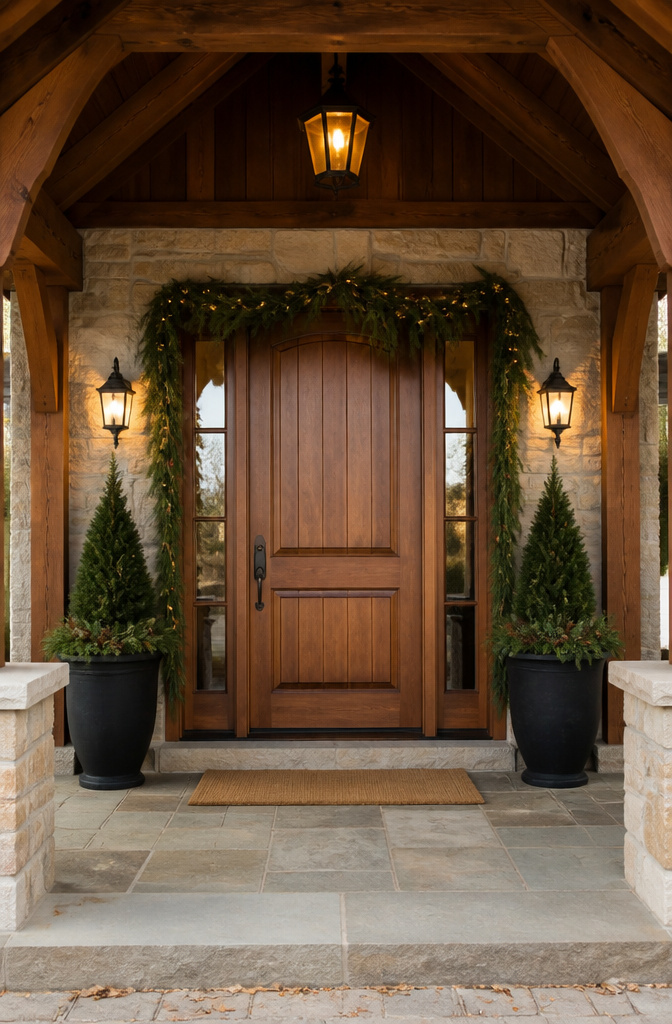
Paired elements on either side of a door pull the eye straight to the center and make the whole entry feel intentional, even when the pieces themselves are simple. Two matching planters with dwarf Alberta spruce, twin sconces with battery-operated candles, or identical wreaths hung at the same height all do the work of an expensive surround without the carpentry.
The passages point to two ways this plays out. Georgian-style brick with a stone frame already has that built-in center line; a magnolia garland tracing the frame plus a matching wreath locks the symmetry into architecture that was designed for it. For humbler timber double doors, two wreaths that match in material but differ slightly in size or hang at staggered heights keep the balance from feeling like a church facade.
Symmetry helps most when your door has no strong feature of its own; it borrows formality and gives a rental or starter home presence it otherwise lacks. The risk is stiffness. A door with sidelights or a transom already reads grand; mirror-image garlands and potted plants can push it toward department-store display rather than welcome. On those houses, loosening one side, maybe swapping a planter for a single lantern at a different height, keeps the harmony without the rigidity.
Cost stays reasonable because the pairing is the trick, not the item. Two $25 wreaths from a craft store read as deliberate where one alone looks spare. The work is in measuring heights and stepping back to check alignment, not in the spend.
10. DIY Projects
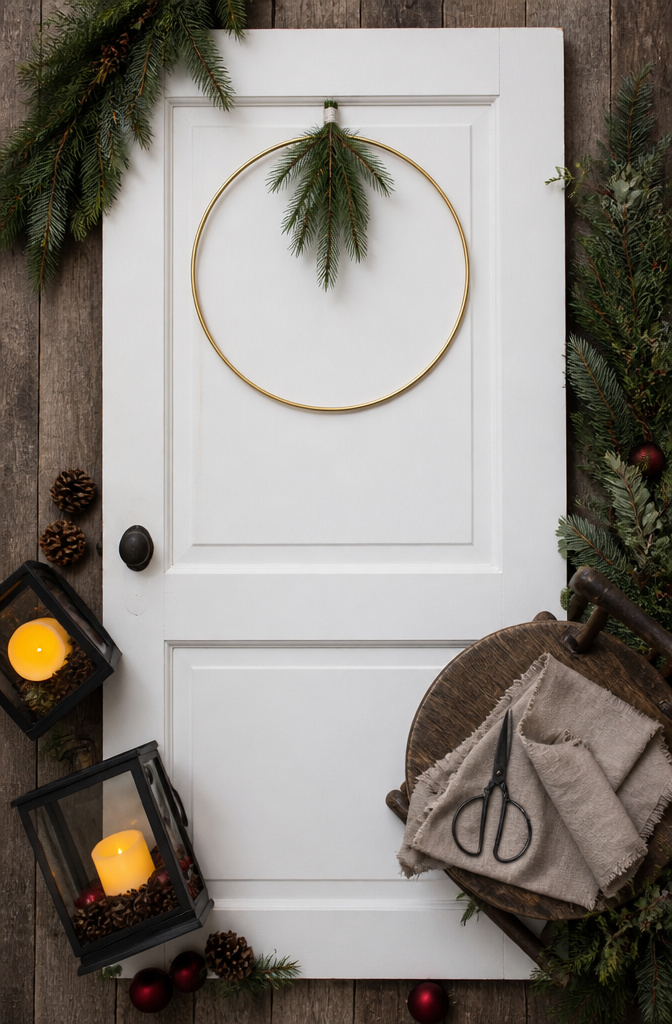
A brass hoop and a single sprig of fir make a wreath that costs maybe twelve dollars and twenty minutes. The first time I tried the fuller look, I spent forty on mixed greens that dried brittle and shed needles for three weeks. That single sprig route stays neat, and if the stem wilts slightly, it braids fine and dries into place.
Doorframe garlands with shatterproof ornaments look dimensional when you mix matte, glossy, and glitter finishes. Ribbon runs about four dollars a yard, and shatterproof balls come in boxes of twelve for under ten. The trick is spacing: too close reads cluttered, too sparse reads forgotten. I mark every eight inches with painter’s tape before I start hanging.
Lanterns flanking the door need greenery at the base, not just for looks but for stability on steps. Pinecones or berry sprigs tucked around the bottom keep the frame from tipping in wind. A brass glass lantern like the Crail IP44 works year-round, so the Christmas part is just what you wrap around it.
The gap between the saved photo and Saturday afternoon is usually scale. Pinterest shots use doors that are six inches taller and wider than standard US frames, with professional lighting. Build for your actual door, shoot in late afternoon when your bulbs are on, and the result holds up to real life.
What Trending Means This Year
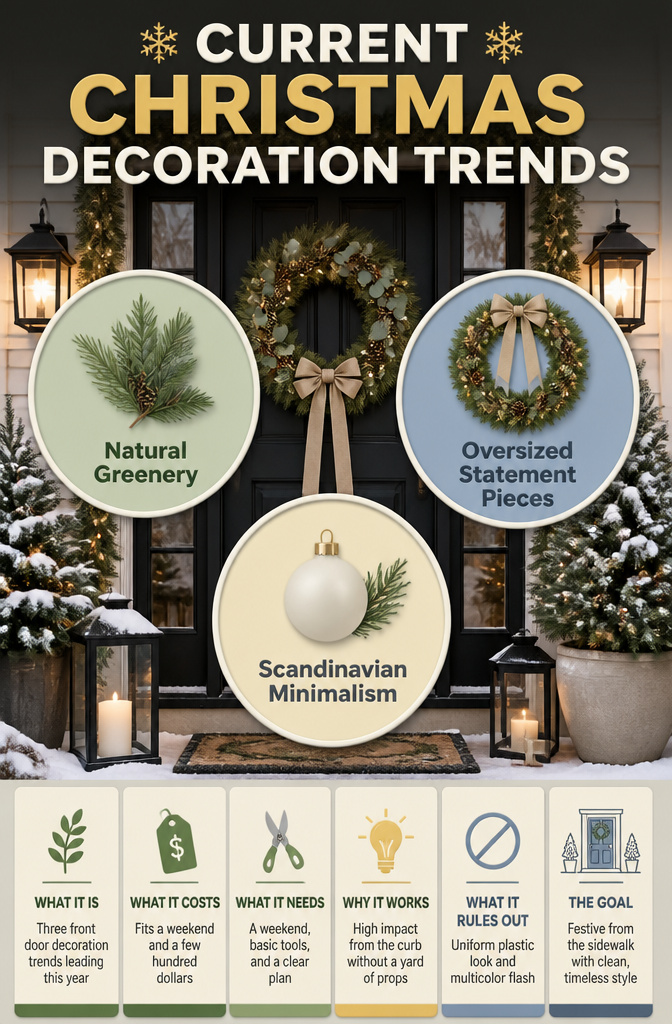
Three trends keep surfacing in what stores are pushing and what people are pinning for their front door decorations for christmas: natural greenery, oversized statement pieces, and Scandinavian minimalism. The greenery trend means real or realistic faux pine, cedar, and eucalyptus replacing the uniform plastic look of a few years back. Oversized statement pieces, like giant wreaths, are being marketed heavily because they read as high-impact from the curb without requiring a whole yard of props. Scandinavian minimalism strips the palette down to matte ornaments, warm white lights, and clean lines rather than multicolor flash.
The ten ideas ahead map cleanly onto these currents without chasing any single one. Some lean into the greenery directly. Others borrow the scale of the oversized trend through proportion rather than literal size. A few pull the restraint and palette of minimalism into formats that still feel festive from the sidewalk. What they share is that each fits a weekend and a few hundred dollars, not a design-team budget.
Starting From a Focal Point
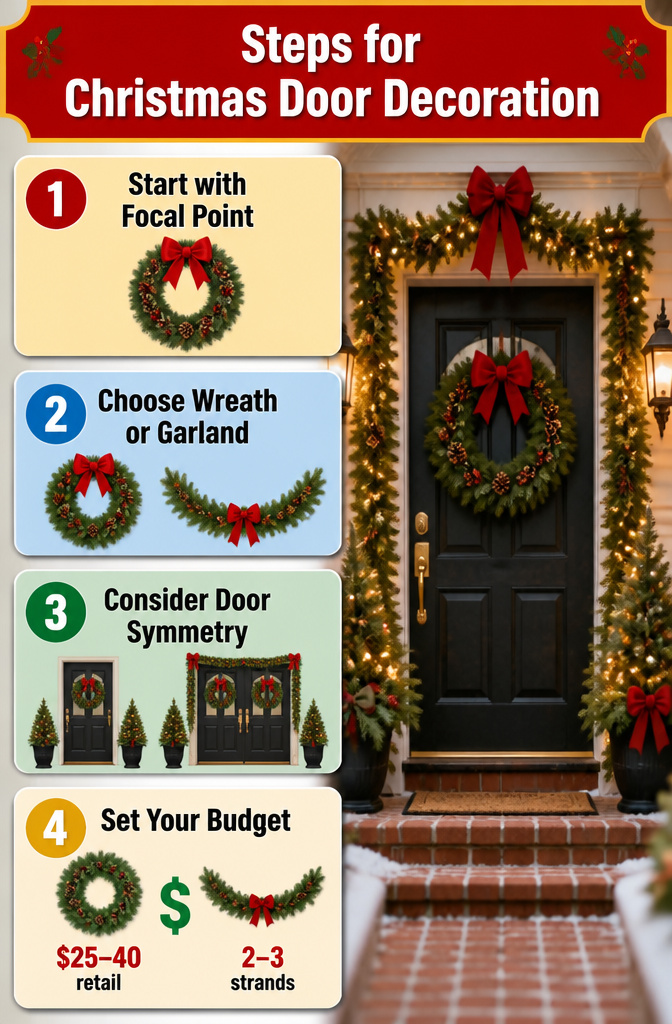
A wreath or garland gives the eye somewhere to land before the rest of the door makes sense. I start there because without that anchor, lights and greenery read as clutter instead of layers.
Wreaths suit narrow doors and tight budgets; one good piece does the work of several. Garlands need more linear space, a door surround or sidelights to drape across, and they scale up fast in both greenery and ribbon cost. Christina Gore’s point about scale and shape matters here: a swooped garland that follows the architectural lines looks intentional, while a too-short strand hung straight across floats awkwardly.
Symmetry helps decide. A single door with no flankings calls for a single wreath or a cluster of varying sizes. Double doors or a door with twin sidelights can carry matching wreaths or a garland mirrored on both sides. No architectural element to center on? Twin planters or identical lanterns on either side of the step create the anchor yourself.
Budget breaks the tie. A natural wreath starts around $25–40 retail, and adding your own trailing ivy, eucalyptus, or dried stems runs cheaper than a built-in light-up version. Garlands run longer per foot and usually need two to three strands for a full drape, so the material cost doubles or triples before lights enter the picture. If the weekend budget sits under $50, the wreath wins.
Renters’ Limits and Workarounds

Command hooks rated for outdoor use carry most of the load here. The small ones handle a lightweight wreath; the medium strip holds garlands or a wooden sign up to about two pounds. Anything heavier and the adhesive strips start peeling in cold rain, which I learned the hard way one December morning.
Over-door hangers work when the hook faces outward, though the gap between door and frame matters. A thick hanger on a tight fit scrapes the jamb every time someone enters. The collapsible wire frames that twist down to a flat coil solve the storage problem that permanent fixtures create. A 24-inch wreath frame stores in a shoebox; a rigid grapevine version needs half a closet shelf.
The real limit is what you can remove in ten minutes if the landlord drives by or the lease ends mid-December. Tension rods inside the frame, magnetic hooks on steel doors, or a leaning arrangement that never attaches at all keeps the deposit safe. I skip anything that needs a drill, and I skip anything that needs storing in the one closet already full of summer fans.
Weekend Timeline and Order of Operations
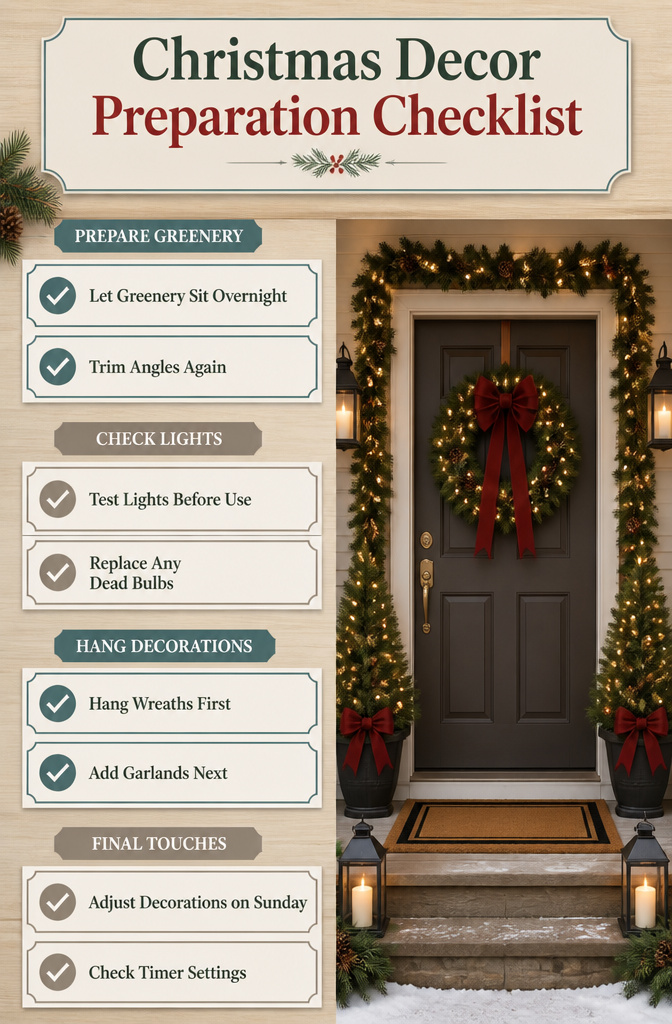
Fresh greenery needs a full night inside the garage or a covered porch before it goes up. The cut ends drink in water even without a bucket, and stems that still feel damp against your wrist will droop the moment they hit dry winter air. I lay mine out on newspaper Friday evening, trim the angles again, and leave them till Saturday morning.
Test every strand of lights while they are still in the box from storage, not after you have wound them through a garland. One dead bulb at 4 p.m. means pulling the whole thing apart in the cold or living with a dark gap till New Year’s. Saturday afternoon is for hanging: wreaths first, then garlands, then the plug-in pieces. Sunday is only for stepping back and adjusting. The bow tilts, the lantern sits an inch too low, the timer clicks on fifteen minutes after you wanted it to. Small fixes look obvious after coffee and a night’s sleep, and they take twenty minutes instead of the two hours you would have spent fixing Saturday’s rushed placement in the dark.
Budget Reality for Under $300

Most people I see in forums and comment threads land somewhere between $150 and $300 for a full front door setup, and the ones who blow past that usually do it on impulse buys rather than a plan. One strong statement piece eats up about half that budget and carries the whole display, while spreading the same money across ten small items leaves the door looking scattered from the street.
Wreaths run the widest range, from basic greens under $40 to preserved or designer versions that hit three figures before shipping. Garlands scale by the foot, so a standard six-to-eight-foot door surround multiplies fast; the cheap ones look it by year two, and the mid-grade wired versions hold shape longer for roughly double. Lights are where renters especially overspend, buying permanent-style clips and timers for a temporary install. Battery-operated strands with built-in timers skip the outlet hunt and come back down in price every October.
Bows look like an afterthought but they are the cheapest way to unify mismatched pieces. A $12–$18 wired ribbon in the right color ties together a wreath, garland, and lantern that came from three different stores. My own tendency is to blow the budget on the wreath and recover everywhere else, but the opposite works too: a $25 wreath with a $60 bow and good lighting reads expensive from the curb.
Frequently Asked Questions
How to decorate your door for Christmas?
Start with a focal point like a wreath, garland, or oversized bow, then layer in lights and greenery around it. Battery-operated lights with built-in timers skip the outlet hunt, and a matching ribbon ties mismatched pieces together. Most full setups run between $150 and $300 if you plan around one strong statement piece.
What is trending this year for Christmas decor?
Natural greenery, oversized statement pieces, and Scandinavian minimalism are the three trends showing up in stores and on boards. Realistic faux pine and cedar are replacing uniform plastic looks, giant wreaths give curb impact without yard clutter, and matte ornaments with warm white lights strip the palette down to clean lines. Smart lights that shift color without extension cord tangles are another hit for entryways.
What do you put on the door during Christmas?
Wreaths and garlands are the standard starting points, with oversized bows as a simpler single-piece alternative. A 24- to 30-inch bow holds its own from the curb on a standard 36-inch door, while a wreath with mixed greenery and pinecones works for almost any style. Renters can use adhesive hooks, over-door hangers, or tension rods to avoid hardware that leaves marks.