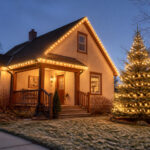
Exterior Christmas lights are the bulbs and strands you hang outside to outline roofs, wrap trees, or fill shrubs during the holidays. The catch is that most people buy the wrong size for the job, turning a two-story gable invisible from the street or making a porch column look like a theater marquee. I learned that the hard way after outlining my own roof with 5mm strands and watching the whole shape disappear from the sidewalk; switching to C9 bulbs the next year finally gave the outline the visual weight I wanted. At just under a dollar per bulb for a 25-bag of faceted C9 LEDs, the mistake is cheap to fix once you know which size belongs where.
C9 LED Bulbs

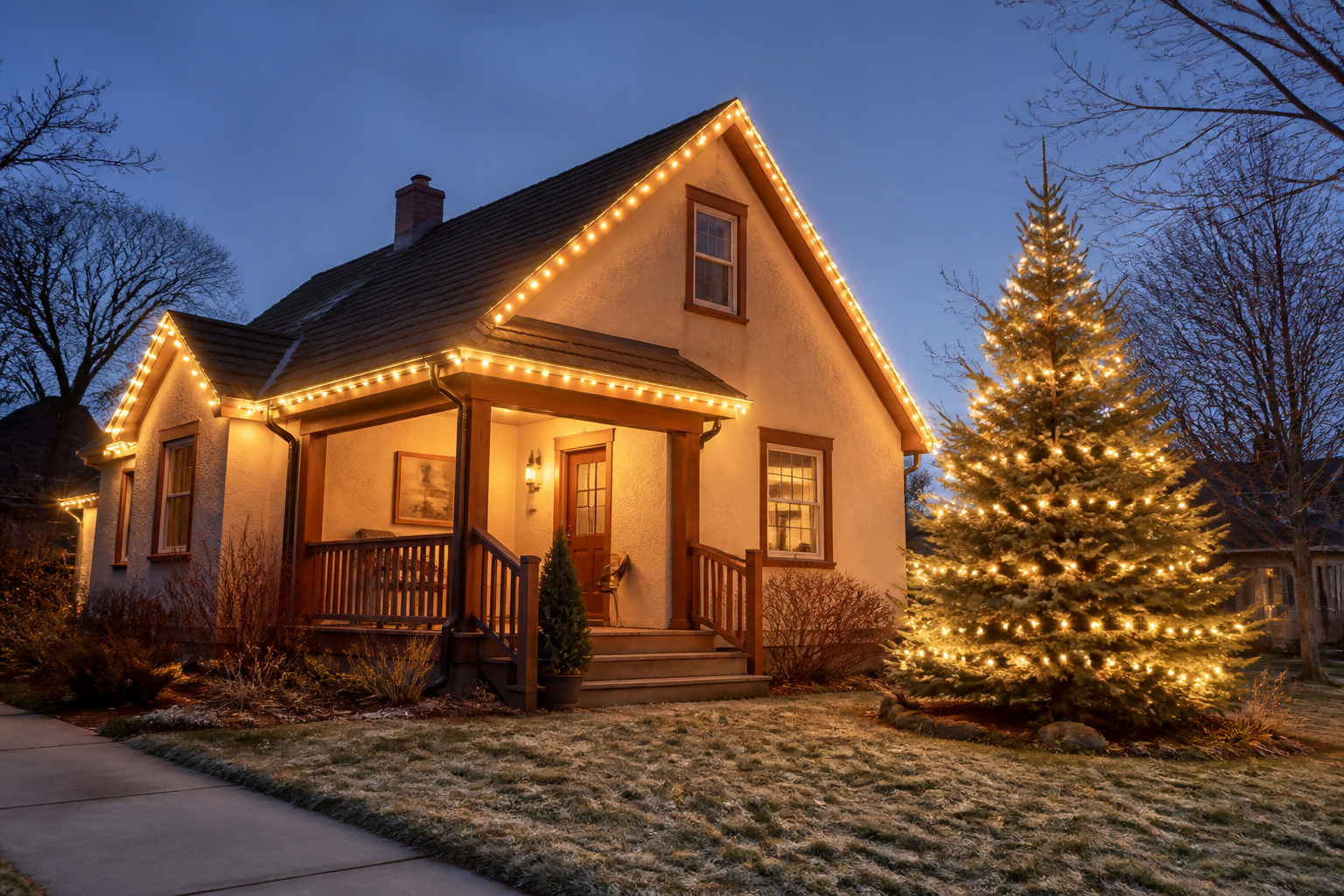
C9 bulbs are the heavyweights of exterior Christmas lights, roughly two and a half inches tall and an inch and a quarter across, which makes them the obvious pick when you want a roofline or a thirty-foot spruce to read from the street. The LED versions run cool and draw a fraction of the wattage the old incandescents did, but they keep that same bold silhouette people expect from classic holiday lighting.
I spent one season trying to outline a two-story gable with 5mm strands, and from the sidewalk the roof disappeared entirely. Switched to C9s the next year and the outline finally showed up the way I’d pictured it. The size difference means C9s carry visual weight at distance, where smaller bulbs flatten into a generic glow.
For warm white specifically, the C9 Platinum Elite LED SMD Bulb (25 bulbs/bag) runs faceted, which throws a slightly scattered light compared to a smooth dome. At $24.75 for the bag, that works out to just under a dollar per bulb. Faceted glass reads brighter from multiple angles, so it suits trees you approach from the sidewalk or a driveway loop. Smooth bulbs pool light more directly; fine for a roof edge viewed straight on, less effective wrapping a trunk you circle.
C7 LED Bulbs

C7 bulbs sit one size down from the C9, and that smaller footprint changes where they belong on a house. The C7 Wonderful LED SMD Bulbs (25 bulbs/bag) run $24.99 in faceted cool white, a price that reflects the tighter spacing these bulbs invite. I reach for C7s when the goal is texture and glow rather than bold outline: wrapping porch columns, threading through wreaths, or filling shrubbery where a C9 would read as oversized and cartoonish.
The scale decision is straightforward. C9s carry visual weight from the street, which makes them the default for rooflines and tall gables. C7s disappear at that distance, so deploying them there wastes the bulb and the labor. Where C7s win is in closer viewing distances where detail matters more than silhouette. A front door flanked with C7s in warm or cool white reads as intentional; the same space with C9s can feel like a theater marquee.
The faceted surface on the Wonderful line breaks up the light more than a smooth globe would, which softens the hotspot that plagues smaller LEDs. At roughly a dollar per bulb, replacing a failed unit does not sting, though the 25-bag format assumes you are planning a zone, not a whole-house job.
5mm Light Strands
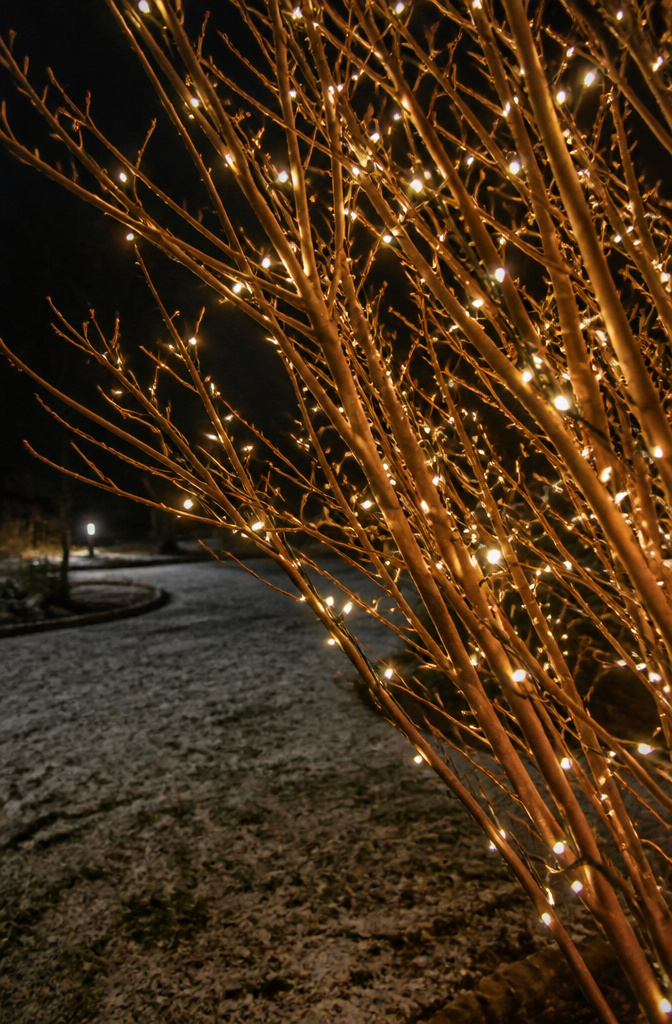
The 5mm in the name refers to the tiny lens diameter, barely wider than a pencil eraser, and that small footprint changes what you can do with a strand. These bulbs sit close together on wire so thin it disappears against bark after dark, which makes them the practical choice when you want a tree or bush to glow without looking like it is wearing jewelry.
Against the C-series bulbs, the difference is application, not quality. A C9 throws enough light to read a house number from the street; a 5mm strand wraps a trunk in dozens of points of light that merge into a single shape at twenty feet. The C bulbs read as decoration. The 5mm strands read as the plant itself catching fire, which is the effect I want on the Japanese maple that sits center-stage in our front window.
Dense wrapping is where they earn their keep. The wire bends tight around twigs no thicker than a shoelace, and the low profile means you can tuck a strand deep into a shrub and still have it read from outside. I have run them through a crape myrtle so thoroughly that neighbors asked when the tree had started blooming white in December.
The catch is the same small size. Step closer than ten feet and the magic thins out into obvious points. They are a distance effect, not a porch-sitting effect, and budget your strands for the yard, not the railing where someone will stand right next to them.
Cluster Lights

Cluster lights pack hundreds of tiny bulbs onto a single strand that folds back on itself every few inches, so the wire disappears and what you see is a solid mass of light. That density makes them the only strand type that can turn a bare winter shrub into something that reads as a glowing form from the street, not just a tree with decorations on it.
The tradeoff is movement. Standard strands drape and sway; cluster strands tangle on themselves the moment you relax your grip, and once they’re up, the compact wiring leaves almost no slack for adjusting. I learned that hanging them on a boxwood that stuck out farther on one side than the other: the dense coverage I wanted on the front left me short on the back, and there was no wire to steal from without creating a dark patch.
Cluster lights belong on shapes that are roughly symmetrical and reachable from all sides: globes, columns, shrubs you can walk around. I would not use them on a tree trunk against a wall, or anywhere you have to guess at coverage from a ladder and hope. The effect is stunning when the geometry works and frustratingly patchy when it doesn’t, and the tangle you fight during install is the same tangle waiting for you in January.
Socket Cords

Socket cords are the backbone of any exterior Christmas lights setup, the part that actually carries power from one end of your roofline to the other. Bulbs screw in separately, so the cord is what you size to your house, not the other way around.
The C9 Socket Cord – 25′ 12" Spacing runs $19.99, which is the length I keep coming back to for standard eaves and porch railings. Twelve-inch spacing hits a middle ground: bulbs read as decorated without crowding, and the cord does not sag under its own weight the way tighter spacing can. Wider spacing exists, though at 25 feet you are usually looking at the same 12-inch standard.
A 50-foot version at $33.99 is also out there, roughly the per-foot savings you would expect. The mistake is buying one long cord and cutting it, or daisy-chaining short ones when a single run would do. Measure your actual linear feet along the fascia, add a couple for the down-run to your outlet, and buy the closest stock length. Leftover cord is not scrap you will use next year; it is cord you stored, forgot the length of, and bought again.
Light Clips
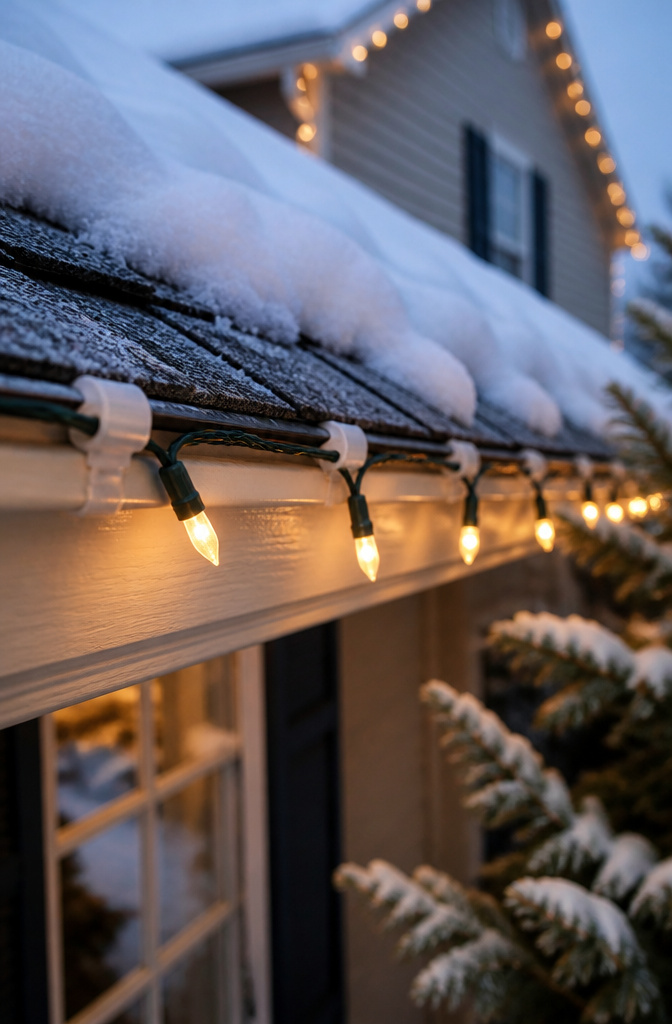
The Smart Clip – Bag of 25 runs about $14.99, and that is usually where I start counting. These small plastic clips hook over the wire and grip shingles or gutters without piercing anything, which matters when the lease says you will pay for every nail hole come January.
I have used them on vinyl gutters, asphalt-tab shingles, and the metal flashing above a garage door. On painted fascia boards they slip, so that is the limit; a strip of adhesive hook there, removed with a hair dryer, has been my workaround. Skip the clips and you end up with the wind doing the uninstall for you, usually around 2 a.m., or with staple holes that rust before the tree comes down.
The count works out to roughly one clip per bulb on C9 strands, maybe one every third bulb on the tighter 5mm lines. For a standard roofline run of 150 bulbs, six bags at 25 clips each covers it with a few spares for the inevitable drop into the shrubbery.
LED Brightness and Energy Use

The numbers on LED packaging finally made sense once I mapped them to my own bill. A strand of warm white C9 LEDs draws about a tenth of the wattage of the incandescent set I used for years, while putting out roughly the same lumens. The cool white option reads brighter on paper with slightly higher lumens, but outdoors after dark the difference is subtle; what matters more is whether you want that blue-white hospital glow or the amber tone that reads as candlelight from the street. Multi-color strands sit in the same wattage ballpark as the whites, though the individual diodes vary.
| Feature | Warm White LED | Cool White LED | Multi-Color LED |
|---|---|---|---|
| Typical lumens per bulb | 7–9 | 9–12 | 6–8 (varies by color) |
| Wattage per bulb | 0.4–0.6 W | 0.5–0.7 W | 0.5–0.7 W |
| Best use | Classic outline, rooflines | Modern facades, white trim | Trees, bushes, playful displays |
The 25,000 hour lifespan claim means you could run these six hours nightly from Thanksgiving through New Year’s for something like eight years before the diodes fade noticeably. My old incandescents cost me a blown bulb every season and maybe $25 extra on January’s electric bill. The switch paid for itself in two winters, and I no longer climb the ladder in freezing weather to hunt for the dead one killing the whole strand.
How I Install Without Damaging Anything

The year I used a staple gun on vinyl siding still makes me wince. The holes were small, but they were permanent, and the landlord noticed in spring. Now I use plastic clips made for the specific bulb size, the kind that grip the wire and hook over gutters or shingles without piercing anything. For brick or stucco where clips won’t grab, adhesive hooks rated for exterior use come down clean with a hairdryer in January.
Extension cords need the same weather rating as the lights themselves. I run cords along the ground with a channel cut into the mulch bed, not across the walkway where ice will hide them. Every connection sits inside a twist-on cover, the cheap clear ones that seal like a jar lid. One damp December I skipped that step and lost half the strand to a tripped breaker by New Year’s.
Ladder work stops the moment the wood or concrete gets slick. Gutters hold frost longer than the ground, so I test with a palm first. If the rung feels cold and damp, the lights wait for Sunday afternoon. The clips go up dry; the bulbs snap in after.
What the Electric Bill Actually Looks Like
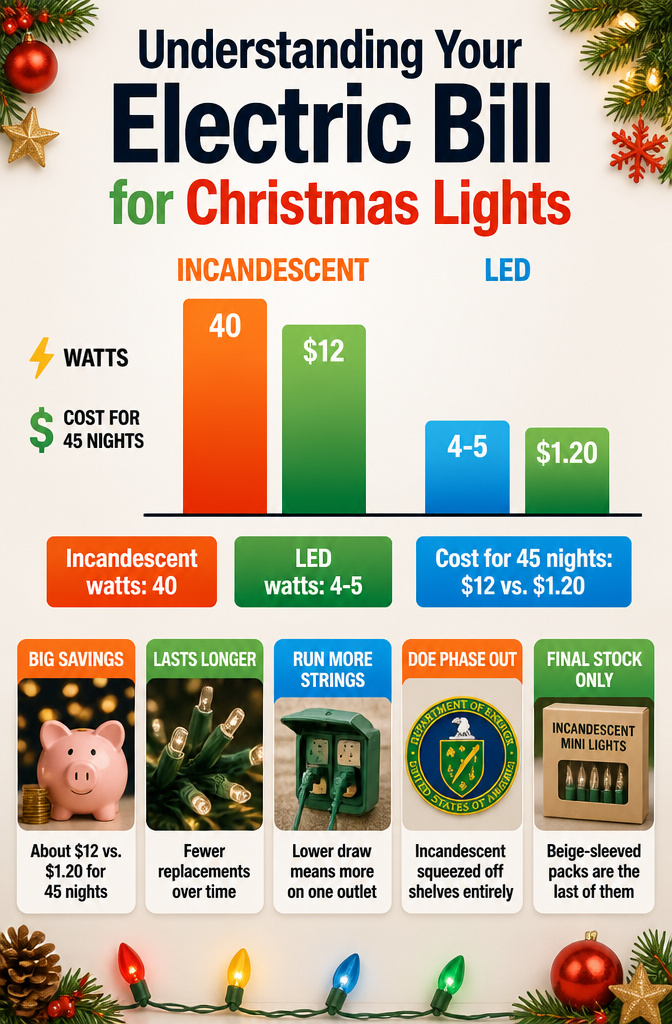
A string of incandescent mini lights pulls about 40 watts, while the same length in LED draws roughly 4 to 5. Over six hours a night for 45 nights, that gap turns into about $12 versus $1.20 on the average residential rate. The math is why every guide leads with the comparison, and why the Department of Energy has now fully committed to squeezing incandescent off shelves entirely. Retailers face fines starting this month, with full enforcement by August, so the beige-sleeved packs still hiding in mom-and-pop hardware stores are effectively the last of them.
For someone renting or stringing their first set of exterior Christmas lights, the environmental angle mostly matters as a purchase signal. LEDs last longer, so you are not re-buying strands every third season, and the lower draw means you can run more strings on a single outdoor outlet before tripping the breaker. The old bulbs are not worth the hunt unless you are chasing a very specific warm glow, and even then the wattage penalty is steep.
Frequently Asked Questions
What are the best types of exterior Christmas lights?
C9 and C7 LED bulbs, 5mm light strands, and cluster lights each serve different purposes. C9s work best for rooflines and tall trees viewed from the street, C7s suit closer details like porch columns and wreaths, 5mm strands disappear into dense wrapping on smaller trees and shrubs, and cluster lights turn symmetrical shrubs into solid glowing forms. The right choice depends on viewing distance and the shape you are lighting.
How do I install exterior Christmas lights?
Use plastic clips sized to your bulb type, the kind that hook over gutters or shingles without piercing anything. For brick or stucco, adhesive hooks rated for exterior use come down clean with a hair dryer later. Run extension cords through mulch beds rather than across walkways, seal every connection in a twist-on weather cover, and stop ladder work the moment wood or concrete feels damp or slick.
Are LED lights better for outdoor use?
Yes. LED exterior Christmas lights draw about a tenth of the wattage of incandescent sets while producing similar brightness, and they carry a 25,000 hour lifespan that translates to roughly eight seasons of nightly holiday use. A typical LED strand costs around $1.20 to run for a full season versus $12 for incandescent, and the lower draw lets you string more sets on a single outdoor outlet before tripping the breaker.