
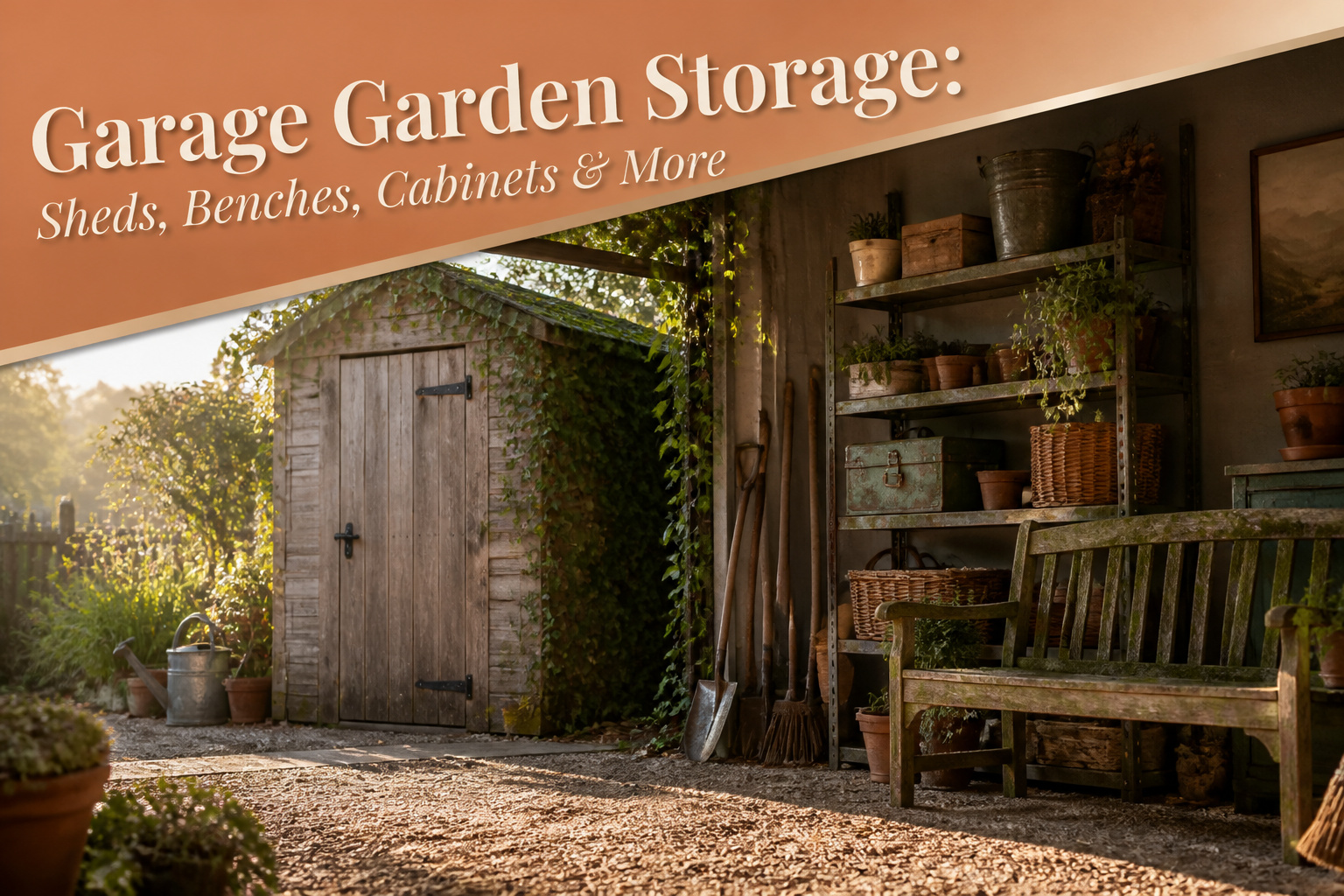
Garage garden storage is the set of cabinets, benches, sheds, and wall systems that keep outdoor tools and supplies inside or adjacent to a garage rather than scattered across a basement or backyard. The catch is that most buyers measure the equipment they own instead of the equipment they actually use, turning a $600 resin shed into a holding area for broken wheelbarrows while the rakes stay in the garage. A 6×4 foot shed fits most sidewalls, but placement matters more than size: face the door toward the garden path, not the driveway, or the twenty-yard walk will kill the habit in a month.
Storage Sheds
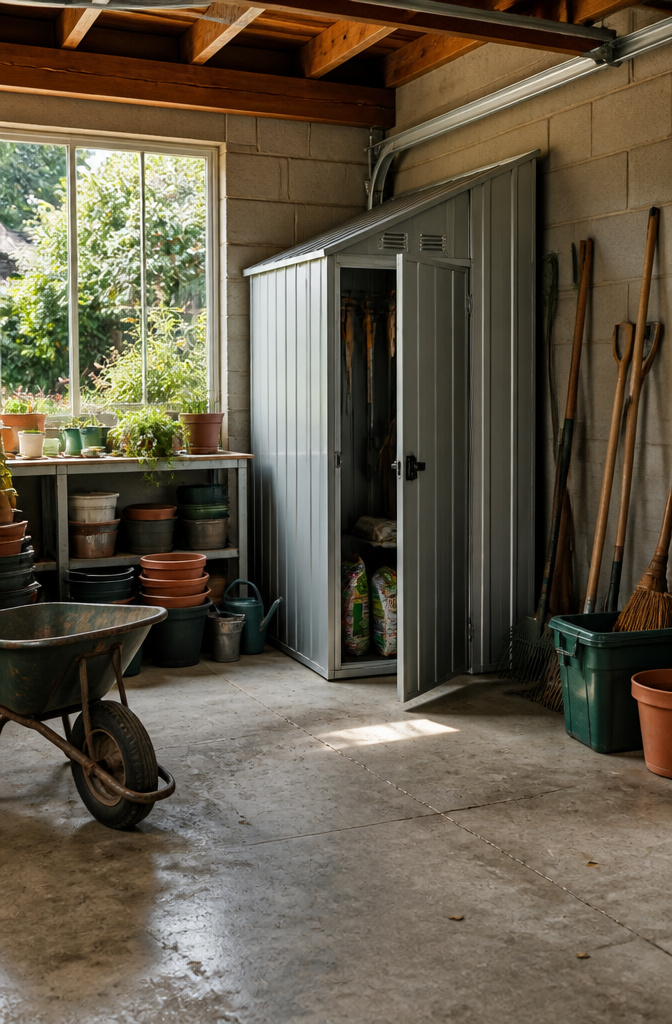
A 6×4 foot shed tucks against most garage sidewalls without swallowing the whole driveway, and that was the size I told myself I needed. The plan was tidy: two rakes, a bag of soil, the hand tools that kept sliding off my garage shelves. What actually ended up in there was a half-empty bag of concrete I was too lazy to carry back to the hardware store, a wheelbarrow with a flat tire, and a tomato cage that never made it to the garden. The tools stayed in the garage, because walking outside to fetch a trowel every twenty minutes turned out to be a habit I wouldn’t keep.
Wood looks right against garden beds but needs attention every couple of years. Metal sheds cost less and arrive faster, though condensation in summer can rust a good pair of shears if you don’t leave a gap for air. Resin sheds split the difference: no rot, no rust, but the thinner panels flex when you lean a full gas can against the wall. For anything larger than 8×10 feet, you are building a small building, not a box, and most renters should pause there. A 10×20 foot structure needs a level pad, possibly a permit, and a landlord who does not mind a second structure on the property. If you own, the same space might serve better as an actual garage extension rather than a freestanding shed you have to cross the yard to reach.
The mistake I made was measuring the equipment I owned instead of the equipment I used. The shed became a holding area for things I meant to fix or meant to throw out, not a working part of my garden routine. A smaller footprint, placed so the door faces the garden path rather than the garage, would have suited the actual pattern of my weekends.
Garden Storage Benches
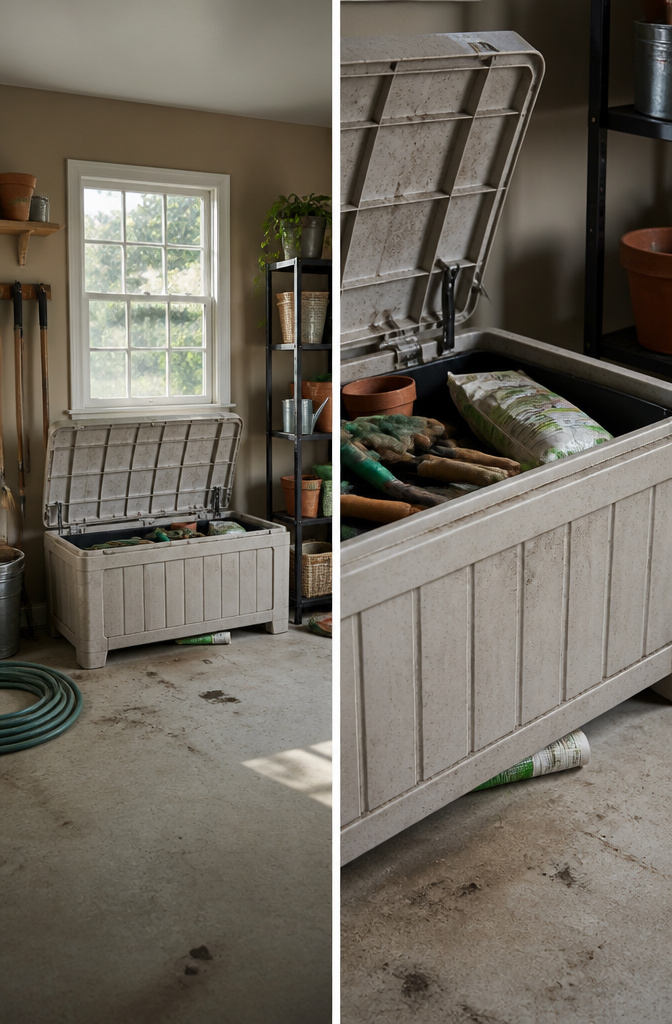
A 50–100 gallon garden storage bench slides into the gap between a garage wall and where the car door swings open, turning dead space into seating that hides potting soil, hand tools, or the sprinkler you tripped over last June. The lid lifts from the top, so nothing protrudes into the bay, and the footprint stays shallow enough that you still walk past without turning sideways.
Mine sits under a north-facing window where direct sun never hits the plastic. That matters more than I expected. The seat surface on cheaper models goes chalky and slick after two summers of UV exposure, but inside a garage the same shell lasts years longer. The resin top on mine has held a 25-pound bag of lime and my weight while I laced work boots, though the hinge creaks now if the bin is stuffed too full. Bulky items defeat the purpose: a leaf blower or half-empty mulch bag blocks the lid from closing flat, and the bench becomes just a bench. What works is the small stuff that otherwise migrates to every flat surface. Trowels, gloves, plant tags, the hose nozzle that disappears weekly. That clutter inside means the seat stays useful, which in a garage is the whole point of the thing.
Wall-Mounted Storage Systems
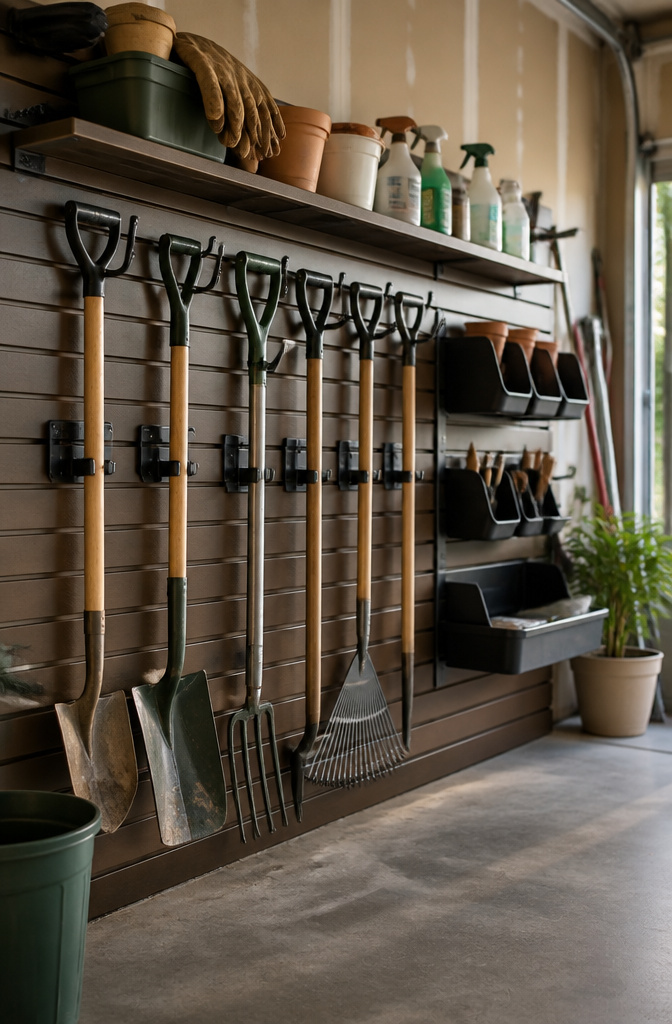
Wall-mounted systems turn the garage’s vertical real estate into storage without eating floor space, but the wall itself decides what actually works. Cinder block, unfinished drywall over studs, and concrete each demand different anchors, and guessing wrong means a shattered terracotta pot or a bent rake tine when the bracket rips free at 2 AM.
Pegboard looks tidy in the hardware store display, yet the fiberboard warps in garage humidity and the small hooks wobble under anything longer than a hand trowel. I swapped mine for PVC slatwall after a full-size shovel walked itself out of the slot three weekends running. Slatwall’s channels grip wider brackets, and the same panel accepts bins, paper-towel holders, or a folded hose reel without new holes.
Individual hooks screwed into a stud handle the real weight, up near that hundred-pound mark if you hit the lumber dead center. A mounted string trimmer, half-full gas can, and long-handled loppers all hang safely there; the mistake is trusting a drywall anchor with a ceramic pot collection or expecting a single hook to balance a coiled hose that swings every time the garage door opens. The tools that hang well share a straight shaft and a center of gravity close to the hook: rakes, hoes, brooms. Anything with a bulbous head, like a bulb planter or a wide spreader, wants a shelf or a cradle instead, or it rotates and knocks its neighbors loose.
The limit is the wall, not the hardware. A finished garage with drywall over studs gives you sixteen-inch centers to hunt for; bare block needs a hammer drill and masonry shields that cost more than the hook itself. Measure twice, buy the anchor rated for more weight than you plan to hang, and expect to move things twice before the layout sticks.
Plastic Storage Bins
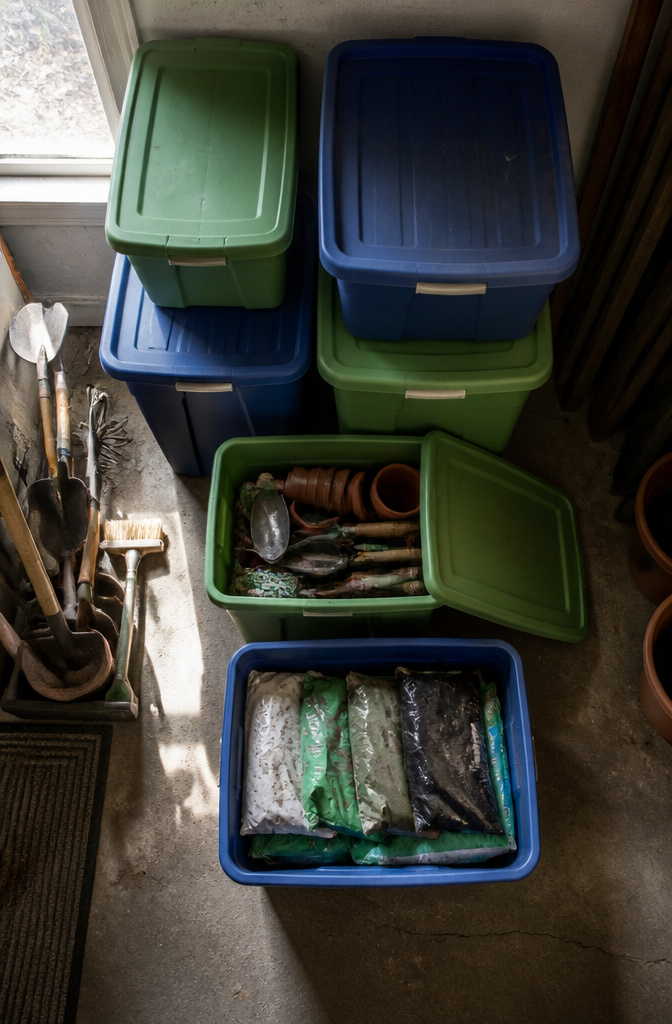
A ten-gallon bin swallows two bags of potting soil or a stack of terra-cotta pots, while a fifty-gallon model holds a coiled hose, a spreader, and hand tools with room still for a bag of mulch. The mid-sizes, twenty to thirty gallons, are the workhorses for seed trays, fertilizer jugs, and the spray bottles that multiply in spring.
Stackability matters more than the sticker claims. Bins with recessed lids nest; those with flat tops slide and topple when the tower gets three high. I tried color-coding by season, green for spring, red for fall, and abandoned it by June when the labels peeled and I could not remember my own system. What stuck was a strip of masking tape on the short side, rewritten with a Sharpie each year, because the reader facing the stack sees the short side, not the lid.
Lid durability splits by hinge style. Snap-all-around lids crack first at the corners, usually the second winter in an unheated garage. Hinged lids on the longer edge fare better; the flex point moves instead of concentrating stress. I lost two snap-lid bins to January cold, the plastic going white at the corner and then splitting when I lifted them. The hinged ones, three years in, still close tight.
Tool Cabinets
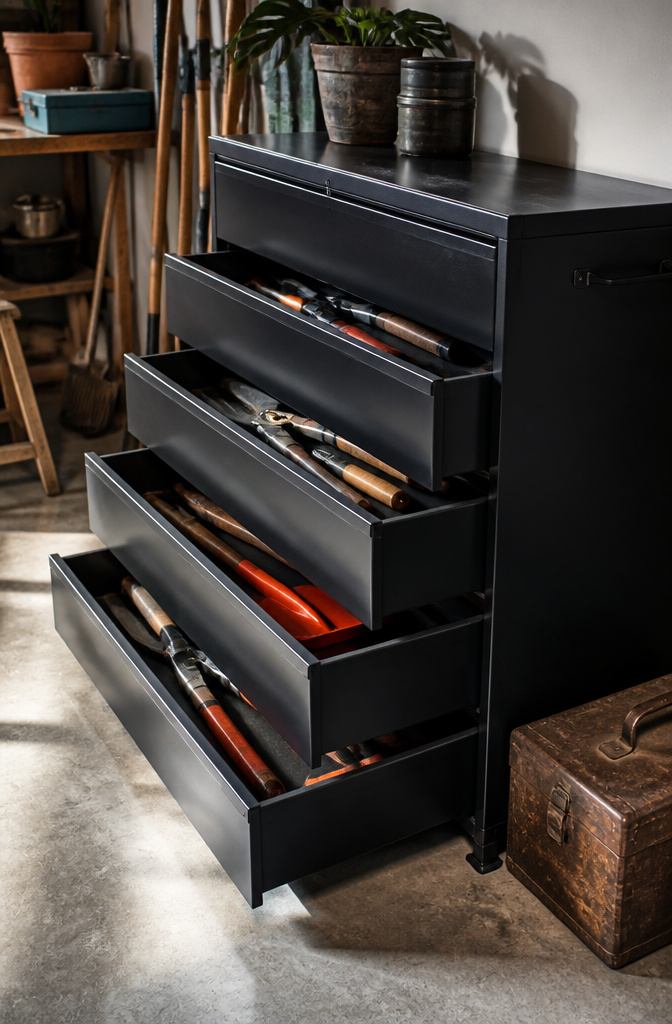
A decent tool cabinet for garden gear starts around $120 and runs to about $450 before you are paying for mechanic-grade branding. The jump from the bottom to the middle is mostly steel thickness and whether the drawers glide on rollers or stick on simple slides. The jump from middle to top is powder-coat quality and how well the latching keeps dust out.
Drawer depth is where garden tools fight back. A standard 18-inch drawer swallows a trowel or pruner but leaves long-handled loppers or a full-size shovel handle jutting out, which means the drawer never quite closes and the seal never quite seals. What convinced me, reading through a dozen of these listings, is that a 24-inch depth is the practical minimum for anything with a handle over 12 inches, and only the mid-range cabinets and above reliably offer it. The budget units often pad their specs by measuring the cabinet shell, not the usable box.
Rust prevention in a garage is half the cabinet and half what you put inside. Even powder-coated steel sweats in a humid garage, especially if the concrete slab wicks moisture up from the ground. A cabinet with a raised base, even an inch or two, buys you more than you would think. Inside, a cheap rechargeable dehumidifier or a few silica packs in the drawer corners costs under $20 and outperforms a fancier finish on the steel. I would skip the units that advertise "weather resistant" without a specific raised foot or gasket detail; that word usually means the paint survived a salt-spray test, not that your garage in July will stay dry inside.
Rolling Carts
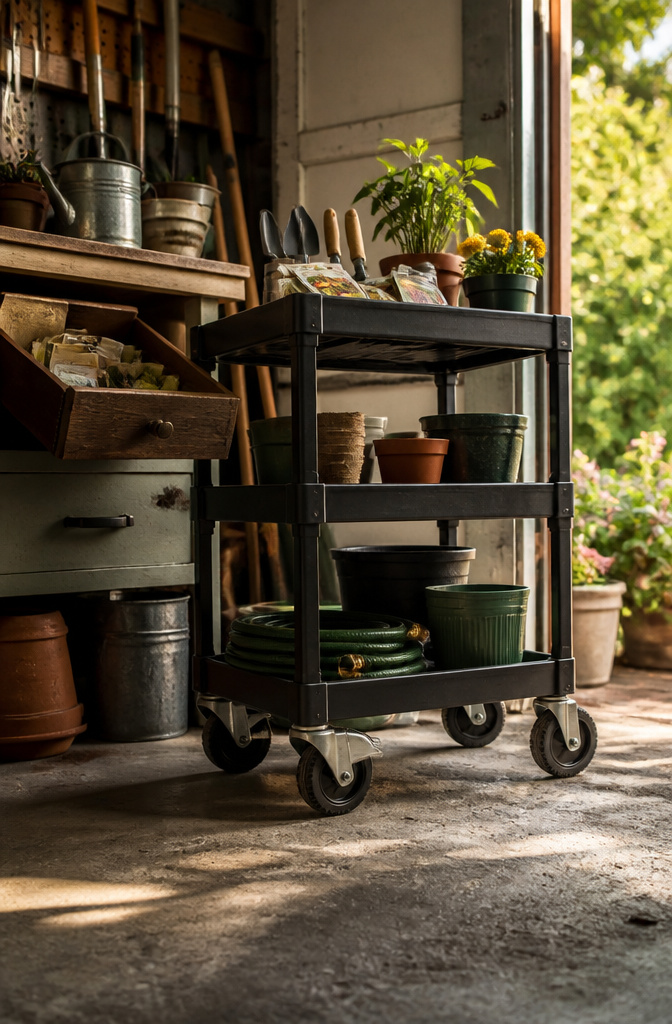
A three-shelf cart with a solid top tray handles the daily rotation better than taller wire units that list when you round a corner. I started with a four-tier model on 2-inch hard casters, and the wheels flat-spotted within a month of rolling across cold concrete; the cart now lives permanently in the garden shed because it shudders crossing the threshold. Swiveling rubber wheels at least 3 inches in diameter hold up on expansion joints and the grit that collects near garage doors, though the trade is height: a taller cart with small wheels tips backward when the top shelf carries a loaded watering can. Two shelves keep the center of gravity low enough to push one-handed across a sloped driveway apron, while anything above four shelves needs to stay in one place or carry only light pots and gloves. Weight belongs on the bottom two-thirds; the top shelf is for flat seed packets or a clipboard, not the ceramic planter you just emptied.
Space Optimization
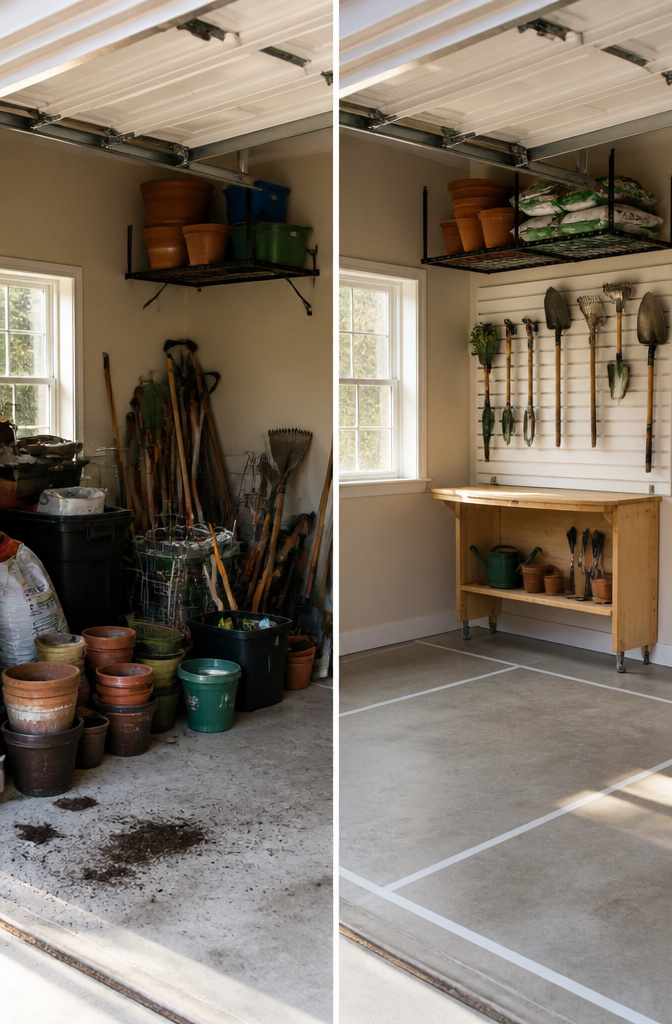
My garage measures 20 by 22 feet, and I once bought a rolling cabinet that looked perfect online but blocked the passenger door of my car by six inches. Measure your clear floor space after the vehicle is parked, not before. I now sketch the layout with tape on the concrete, marking door swings and the arc of the garage door track overhead.
Vertical storage changed everything for me. Wall-mounted slat panels above the workbench hold long-handled tools that used to lean in corners, and a ceiling rack over the back third of the bay stores pots and soil bags I access with a stepladder. The floor space beneath it stays open for the car and for a folding potting bench I wheel out on weekends.
That bench is the one multi-functional piece I kept. It closes flat against the wall, opens to a 36-inch work surface with a soil catch tray, and the lower shelf doubles as storage for hand tools. For renters, furniture that moves or folds beats anything bolted to studs you will patch later.
The cabinet I returned taught me the last rule: add four inches to any stated depth for open drawers or doors, and walk the path you will use with a loaded wheelbarrow. My clearance looked fine on paper, but the tight turn from garage to backyard gate scraped paint off both handles.
Weather Resistance
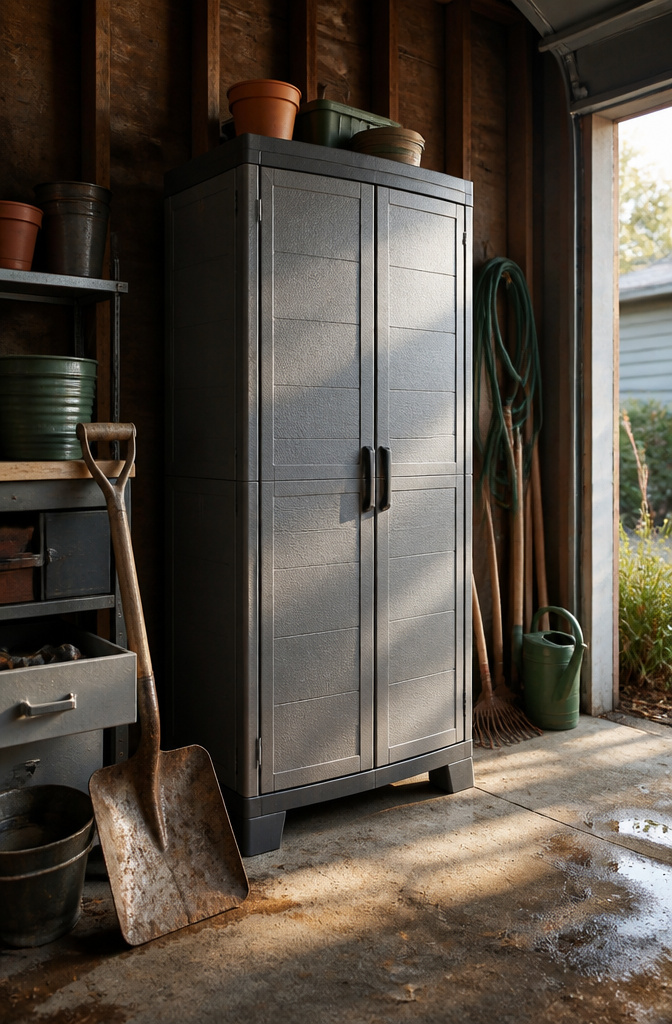
Resin held up better than anything else in my unheated garage, where winter drops below freezing and summer humidity sits thick enough to rust a nail in a season. Treated wood seemed like the safe middle ground, but the moisture cycling warped the lid on a storage bench I’d bought as a "lifetime" piece; within two years it bowed enough that the latch wouldn’t catch. Bare metal fared worst. A cabinet I picked up cheap developed orange bloom at every seam by spring, and the drawer slides started grinding like sandpaper. I replaced both failures with a resin unit that cost about sixty dollars more upfront but has stayed square and smooth through four years of the same cycles. The resin does get brittle in deep cold, so I avoid slamming drawers in January, but that is the only concession it asks for.
Cost Considerations
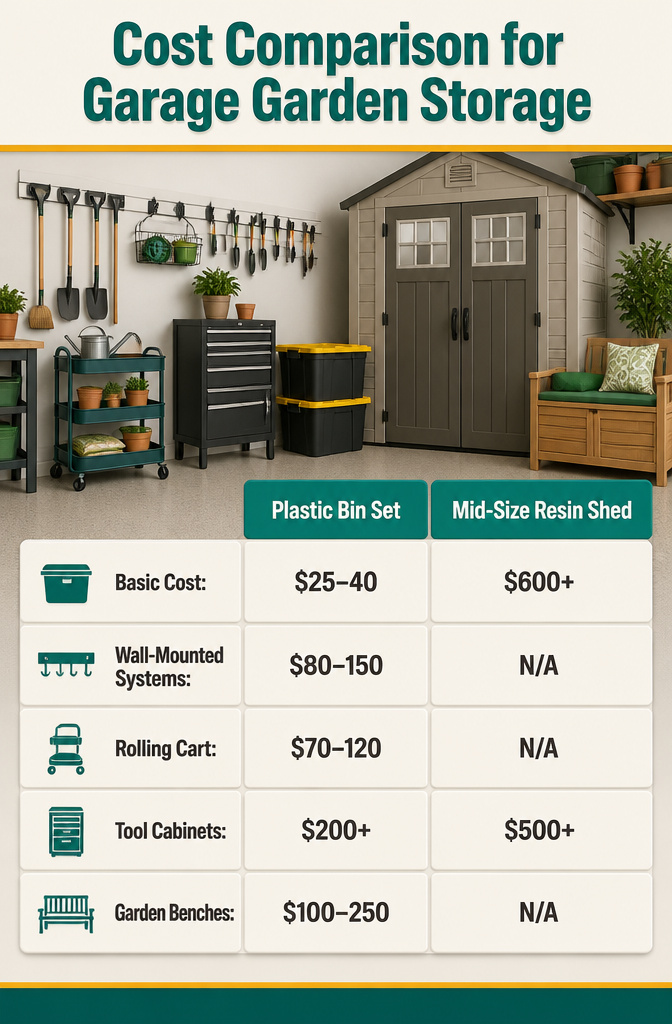
The cheapest garage garden storage option, a basic plastic bin set, runs about $25–40, while a mid-size resin shed can push past $600 before delivery. Wall-mounted rail systems with a few hooks land in the $80–150 range, and a rolling cart sturdy enough for a loaded watering can sits around $70–120. Tool cabinets start near $200 for a bare metal box and climb past $500 once you add weather sealing and casters. Garden benches with built-in storage run $100–250 depending on whether the seat is slatted wood or molded resin.
My own three-year total came to roughly $1,100, and $340 of that went to replacing things I bought too cheap the first time. The $15 wire shelf that rusted through in one season, the bin lid that cracked after a winter freeze, the cart whose wheels flattened under a bag of potting mix. Each seemed like a small savings at checkout. The $300 I wish I had spent differently went to a second rolling cart instead of a wall system for long-handled tools; the cart handles the heavy stuff fine, but the shovels and rakes still lean in a corner, scratching the car every time I pull in.
DIY Storage Solutions
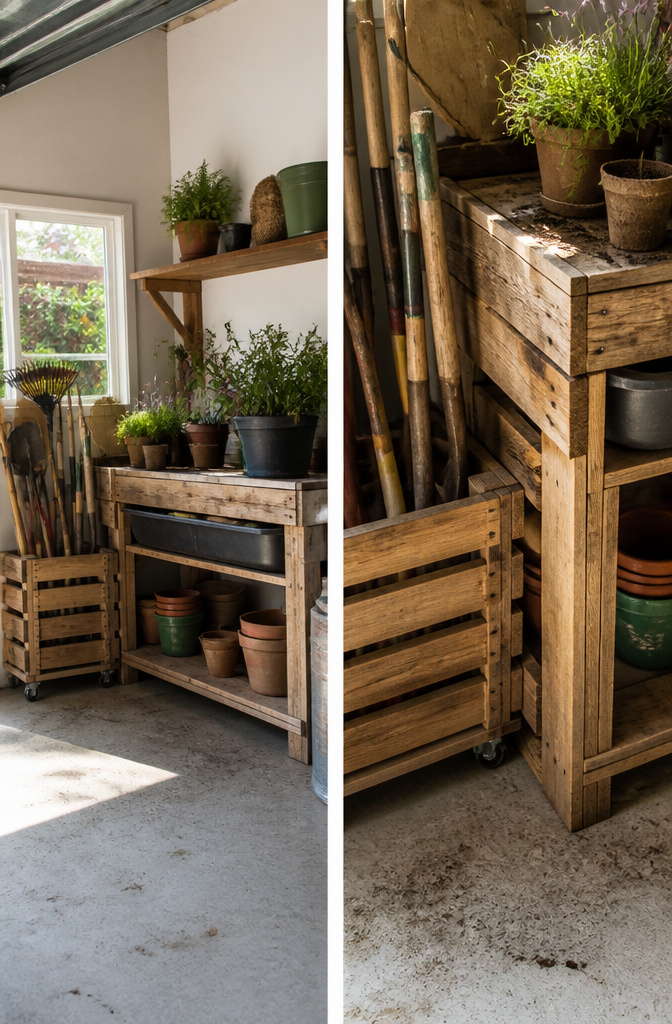
Pallet wood looks free until you count the hours. Three summers back, I built a potting bench from two heat-treated pallets I found behind a garden center. The slats were oak, hard as nails, and the rusted ring-shank nails took two evenings to remove without splitting the boards. The bench itself held up fine; the shelf underneath, where I skimped on bracing, sagged within six weeks once I loaded it with half-empty bags of potting mix.
The success was simpler: a rolling bin for long-handled tools built from a single pallet and four casters from a thrifted office chair. I cut the stringers to form a shallow box, left the deck boards as the back wall, and screwed the casters into blocks I glued and screwed to the corners. It rolls under the workbench when the garage needs to fit a car, and the total time was maybe three hours including the trip for the casters.
What I learned was that pallets work when the project stays small and the stress stays low. Anything that carries real weight or sits outdoors long-term wants pressure-treated lumber or a store-bought frame. The potting bench got rebuilt that fall with two-by-four legs and the original oak slats as cladding only. It looked nearly the same, but it stopped wobbling.
Seasonal Storage Tips
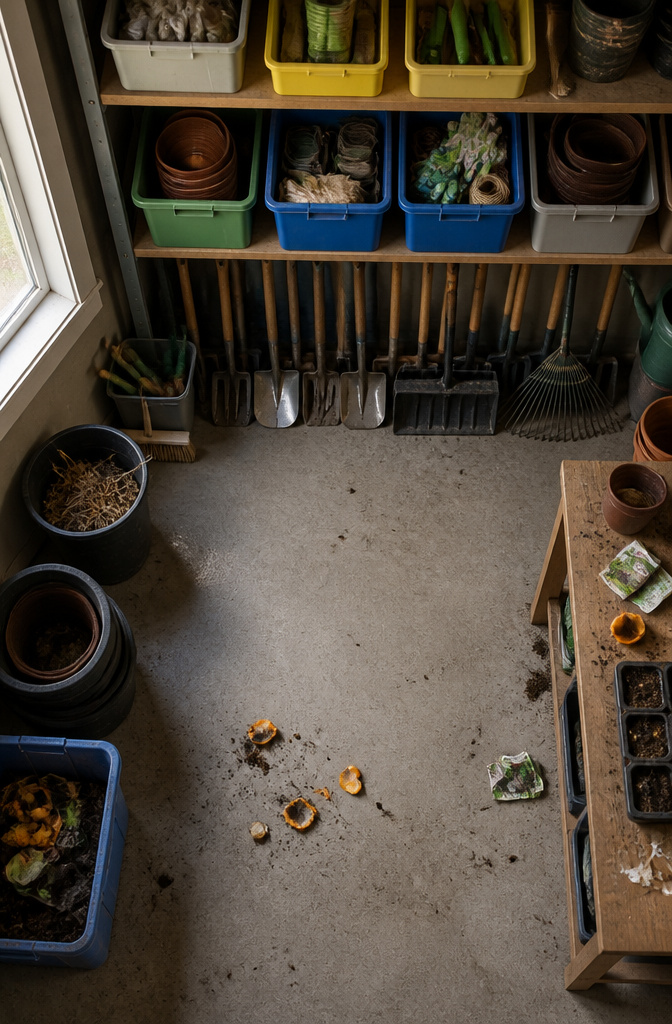
Rotating tools by season keeps the garage from turning into a junk drawer with a door. In late October I move the pruners, loppers, and hand fork to a bin on the lower shelf, right where I can reach them without moving the snowblower. Summer gear, the watering wands and hose nozzles, goes up high in a cabinet I only open when the ground thaws.
A label on three sides of the bin is what saves the spring morning. I learned that the hard way after packing the trowel into a "winter tools" tub with a lid that only faced one direction. I spent twenty minutes in March pulling out every container, reading the one label I had stuck on top, which of course faced the wall. Now I mark the short ends too, in thick marker, because bins end up sideways when you are in a hurry.
The rotation itself takes about an hour if I do it while the soil is still workable. Waiting until the first freeze means gloves too stiff to grip and a reluctance to sort anything properly. I also keep one small tray of crossover items, the twine and the hand rake, that stay out year-round. Everything else commits to a season, or it starts to live everywhere and nowhere at once.
Frequently Asked Questions
What is the best way to organize garden tools in a garage?
Wall-mounted systems and labeled storage bins are the most practical approach. PVC slatwall handles wider brackets better than pegboard, which warps in garage humidity, while bins with masking-tape labels on the short side keep small items from migrating to every flat surface. Reserve floor space for the car and anything on wheels by putting long-handled tools on the wall and seasonal gear in ceiling racks.
How do I choose the right storage shed for my garden tools?
Match the size to tools you actually use, not everything you own, and place the door facing your garden path rather than the garage. A 6×4 foot shed fits most sidewalls without swallowing the driveway, while anything past 8×10 feet needs a level pad and possibly a permit. Wood looks right but needs maintenance every couple of years, metal costs less but risks condensation rust, and resin avoids both problems though panels flex under heavy weight.
Are plastic storage bins durable for outdoor use?
Hinged-lid models hold up better than snap-all-around styles, which crack at the corners by the second winter in an unheated garage. Resin generally outperforms other plastics in freeze-thaw cycles, though it turns brittle in deep cold and should not be slammed. Stackability depends on recessed lids that nest rather than flat tops that slide; ten-gallon bins suit potting soil and pots, while fifty-gallon units fit hoses, spreaders, and tools together.