Stair climbing delivers six evidence-backed health benefits that transform brief daily movement into measurable improvements in cardiovascular fitness, metabolic health, cognitive function, and long-term mortality risk.
As an “exercise snack,” it compresses cardio into minutes without equipment, matching gym sessions through scattered bursts that accumulate across your day.
Ascending and descending engage muscles differently, with eccentric contractions during descent extending calorie burn for hours afterward.
Two-step climbing intensifies glute and thigh engagement, while just two flights enhance blood flow, problem-solving ability, and executive function through BDNF spikes and mood elevation.
Population studies show 39% lower coronary mortality and 24% reduced all-cause death among regular stair users.
The practice strengthens heart muscles, improves circulation, supports healthy blood pressure, and reduces metabolic syndrome risk, particularly when multiple short sessions replace sedentary time.
Practical guidance for implementing each benefit into your daily routine follows below.
Why Stair Climbing Works as an “Exercise Snack”
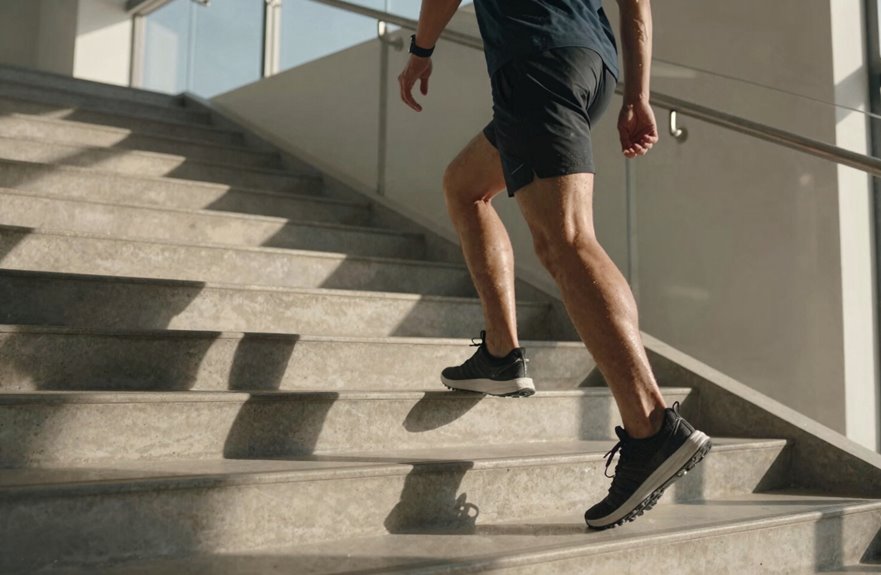
Why does something as simple as climbing stairs deserve your attention? Because stair climbing functions as an exercise snack: brief bursts of activity you can slip into ordinary moments without equipment or gym memberships.
Stair climbing: the exercise snack you can slip into ordinary moments, no equipment required.
Understand VILPA, or vigorous intermittent lifestyle physical activity. Stair climbing delivers exactly this concept. You accumulate daily activity through scattered sessions, perhaps three flights now and two later, rather than one exhausting block. Research confirms people stick with multiple small stair-sessions better than single prolonged workouts.
Each climb elevates your energy expenditure above sitting. These brief bursts improve cardiorespiratory fitness and trigger immediate cardiovascular benefits: elevated heart rate, increased oxygen consumption, and enhanced brain blood flow. You’re not just moving; you’re building sustainable habits that reduce sedentary time at work or home.
This accessibility makes stair climbing a practical foundation for lasting health integration.

【MAKE DAILY CARDIO EASIER WITH THE ORIGINAL STEPPER】 Bring more movement into your routine with the Sunny Original Stepper, a compact mini-stepper designed for convenient at-home cardio with 2 included resistance bands for added upper-body training.

ADJUSTABLE RESISTANCE:There are 3-level high-intensity spring resistances .Variable resistance levels let you customize workout intensity to match your fitness goals and experience.

【Full-Body Stair Stepper for Effective Workouts】 Experience a complete workout at home with this stair stepper with handlebar, designed to simulate natural climbing. It engages your core, legs, glutes, waist, and back simultaneously, combining cardio with muscle toning for maximum calorie burn in less time. Just 20 minutes on this stairmaster machine for home equals the benefits of jogging, swimming, or cycling.
Match Gym Cardio Benefits in Minutes, Not Hours
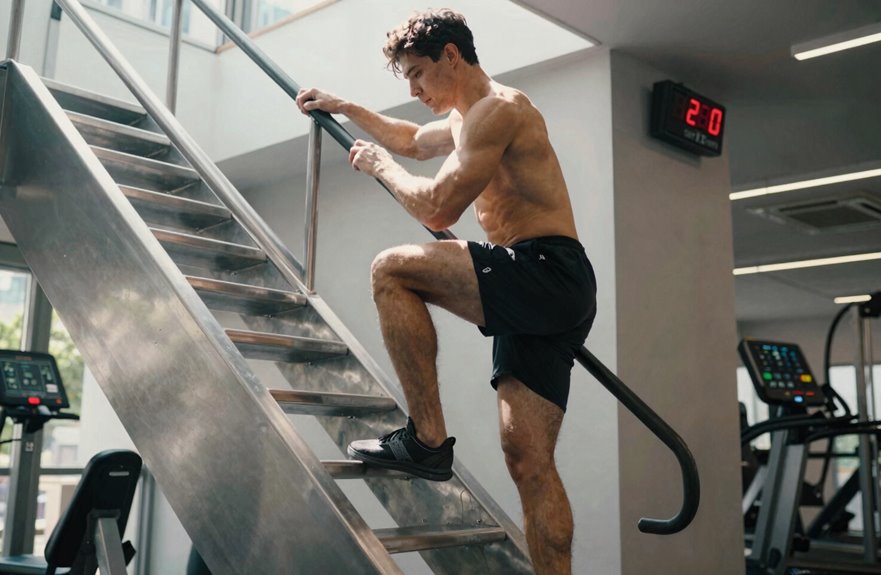
I don’t need hours on a stair machine to strengthen my heart. Short bursts of real staircase climbing deliver equivalent cardiorespiratory benefits in far less time, with studies showing that just a few minutes of daily effort can match longer gym sessions. This time-efficient approach protects my cardiovascular health without demanding my entire schedule.

【COMPLETE BODY WORKOUT COMBO】The 2-IN-1 Stepper engages your glutes, quads, hamstrings, and calves with step-ups and downs, while the integrated arm resistance bands simultaneously challenge your biceps, triceps, shoulders, and core.

Full-Body Workout in One Compact Stepper: Not just for your legs. This stair stepper strengthens lower limb muscles and accelerates fat burning with continuous stepping. It also comes with removable resistance bands to work your arms, shoulders, chest, and back—perfect for weight loss, full-body toning, or daily fitness routines

Promote Fat Burning: The Niceday stair stepper accelerates the fat burning of the buttocks and legs through continuous stepping; Persistent high cardio stepper for exercise can quickly reduce the lower limbs' fat and enhance muscle strength, achieving the goal of lifting buttocks and thinning legs
Cardio Equivalence
Because gravity works against you with every step, climbing stairs delivers cardiovascular benefits that rival dedicated gym sessions, often in far less time. Stair activity produces meaningful gains in cardiorespiratory fitness matching structured stair-machine workouts.
When I climb stairs, my elevated heart rate and oxygen consumption surge immediately. This stair climbing triggers cardiovascular fitness improvements without the gym commute. Research shows stair climbers carry lower risks of coronary heart disease and stroke, with health impacts matching moderate gym activities.
I accumulate these benefits through brief exercise snacks: three minutes here, five minutes there, scattered across my day. Descending and ascending engage both concentric and eccentric muscle actions, promoting efficient energy expenditure. Stair climbing offers practical cardio without the membership fee.
| Activity | Time Required | Cardio Benefit Level |
|---|---|---|
| Stair climbing | 10 min | High |
| Treadmill running | 30 min | High |
| Stair activity (accumulated) | 15 min daily | Moderate-High |
| Gym cycling | 45 min | Moderate |
| Brief exercise snacks (stairs) | 3-5 min × 3 | Moderate |
Time Efficiency
Stair climbing compresses your cardio workout into remarkably brief windows. Time efficiency isn’t about cutting corners; it’s about smart integration of daily activity into your life.
Stair climbing delivers cardio in minutes:
- Short bursts accumulate across your day, matching traditional gym sessions without the commute
- Cardiovascular benefits emerge within weeks, not months, of consistent daily stair practice
- Metabolic risk drops measurably when you exceed five flights daily, providing minimal time investment with meaningful protection
- Daily activity snacks outperform single long workouts for sustainable adherence
You’re not sacrificing results for convenience. Research confirms your body responds to accumulated effort, not extended duration. Stair climbing transforms dead time into health investment.
Heart Health
Your heart doesn’t require marathon gym sessions to grow stronger. Stair climbing delivers measurable cardiovascular fitness in minutes, not hours.
How Stair Climbing Protects Your Heart
Research involving nearly half a million participants shows stair climbing reduces coronary heart disease mortality by 39% and all-cause death by 24%. This represents significant heart risk reduction from a simple daily activity.
This exercise strengthens heart muscles, improves blood circulation, and supports healthy blood pressure levels. Short bursts throughout the day match gym stair machines for aerobic fitness gains. You’ll see cardiovascular benefits within weeks of starting.
Stair climbing replaces sedentary time with moderate-to-vigorous movement. No equipment needed; just accessible steps wherever you live or work.
Stairs serve as an effective heart health strategy.
Build Leg Strength With Two-Step Stair Climbing
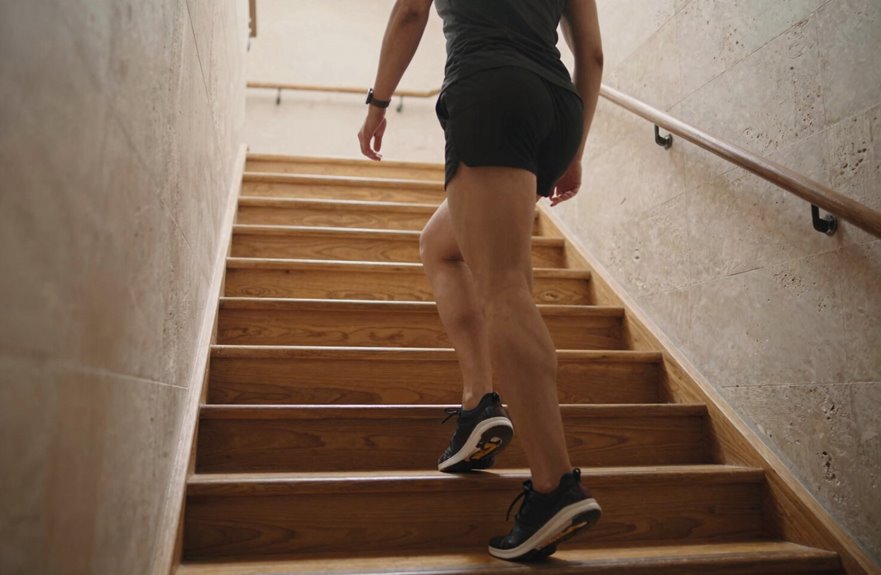
Efficiency drives results when you’re building leg strength, and two-step stair climbing delivers exactly that. This technique transforms your lower body through strategic movement.
Here’s what two-step climbing does for your legs:
- Targets your glutes and thighs more intensely than single steps, forcing larger muscle groups to activate
- Builds lower-leg muscles through increased ankle and knee workload, creating balanced development
- Develops muscular endurance in your calves through sustained, repetitive motion
- Adds eccentric training when you descend, promoting muscle growth and long-term energy expenditure
Stair climbing remains equipment-free and accessible. Short bursts throughout your day align with exercise-snack principles. Regular practice reduces leg fatigue and supports daily activities like walking, climbing stairs, and standing for extended periods. Your calves, thighs, and glutes strengthen together, creating functional power you can measure through improved performance in everyday movement.

【UPGRADED SMART STEPPER W/ MAX WEIGHT CAPACITY 300 LB】 Experience the smart connectivity through the SunnyFit app with the new sleek and compact portable stair stepper. Built with a strong frame supporting up to 300 LBs, it’s perfect for your cardio goals wherever suits you best, whether while watching TV or at your standing desk.

【 Revolutionize Your Fitness Routine 】 The stair stepper with handlebar is the ultimate workout machine designed to mimic the natural movement of rock climbing, engaging your entire body. This low-impact exercise targets multiple muscle groups simultaneously, offering a full-body workout that burns more calories in less time.

SMART STEPPER WITH SUNNYFIT APP: Pair this smart stepper with the free SunnyFit app to access trainer-led workouts, immersive scenic tours, fitness programs, community challenges, and progress tracking for a more engaging at-home workout.
How Two Flights Can Unlock Creative Problem-Solving
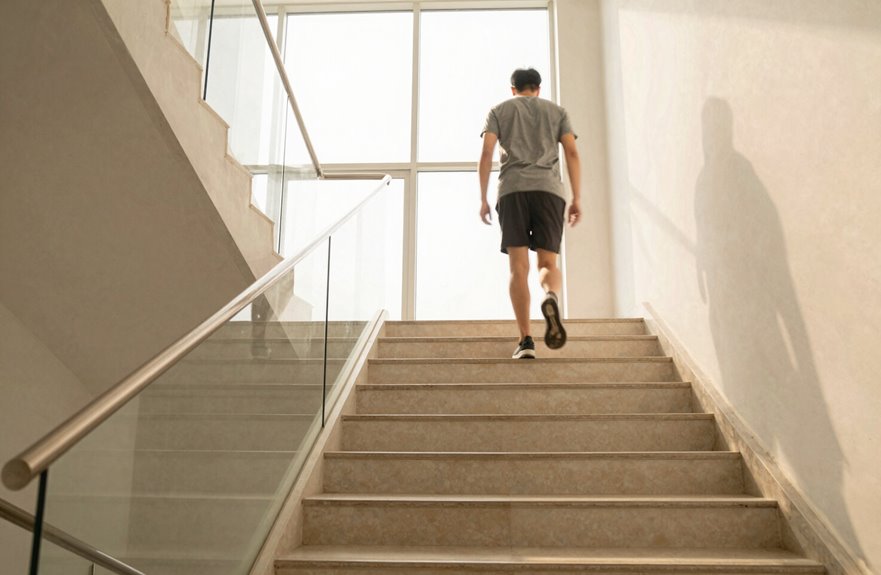
I want to show you how two quick flights of stairs can rewire your brain for better ideas. When you climb, your blood flow surges, delivering oxygen and glucose to regions that generate novel solutions. Research indicates people produce up to 61% more original ideas after stair climbing compared to elevator use, and the mechanisms behind this cognitive boost involve increased cerebral circulation and neurochemical activation.

【Targeted Glute & Thigh Sculpting】 Effectively activate hips, glutes, and outer thighs with professional-grade hip abduction mechanics. This versatile thigh workout equipment delivers focused muscle engagement for toning curves and improving lower-body strength. Ideal as a dedicated booty builder machine for female fitness goals, while also supporting rehabilitation exercise programs for hip and thigh recovery.

Smith-Style Glute Kickback Board: Upgrade your glute workout equipment with a machine-inspired kickback system engineered for higher muscle activation and faster visible glute gains. The guided resistance path precisely targets all glute muscles, helping users achieve a firmer, more lifted look through efficient glute workout and leg workout sessions, while controlled motion improves balance and lower-body strength.

6 levels of resistance from light to strong (20/40/60/80/>80lbs): The ERGOLIFE home hip abductor machine has 6 levels of humanized resistance values, suitable for teenagers, fitness enthusiasts, and the elderly. It only takes 10-20 minutes a day to quickly achieve relaxation to firmness. This body shaping hip abductor machine will accompany you from entry to breaking through your own limits
Cognitive Boost Mechanisms
Scale two flights of stairs and your brain responds almost immediately. This shows exactly how this cognitive boost happens, so you can use it yourself.
How Stair Climbing Rewires Your Brain
- Brain blood flow surges, delivering oxygen and glucose to fuel mental performance.
- Brain-derived neurotrophic factor (BDNF) spikes rapidly, supporting neural growth and faster thinking.
- Cognitive switching improves, letting you shift between tasks with less mental friction.
- Mood elevates through dose-dependent effects. Two flights work best, while five or eight can backfire.
Research confirms stair climbing enhances creative thinking and mental flexibility without exhausting you. The mechanism is precise: moderate exertion triggers optimal biochemical responses. Too little does nothing; too much diminishes returns. Two flights hit the sweet spot for cognitive enhancement.
Creative Thinking Enhancement
How quickly can a simple climb reshape your thinking? Research shows stair climbing delivers immediate cognitive benefits that directly enhance creative thinking.
How Two Flights Unlock Problem-Solving
A Yamaguchi University study found two flights of stairs specifically improve focused problem solving, while longer climbs do not. This short vigorous activity triggers optimal brain blood flow without causing fatigue that impairs cognition.
Executive Function Enhancement
Stair climbing boosts executive function through improved cognitive switching, the mental flexibility that lets you shift between ideas and inhibit irrelevant thoughts. These mechanisms support creative breakthroughs when you’re stuck on challenges.
Practical Application
- Climb two flights when facing creative blocks
- Pair with quality sleep for next-day memory benefits
- Use as a midday reset between demanding tasks
Strategic movement builds cognitive readiness. The research demonstrates measurable improvements in problem-solving ability and mental flexibility through this simple intervention.
Why Descending Stairs Burns Calories for Hours After

Why does walking downstairs leave you burning calories long after you’ve finished? Descending stairs triggers unique physiological responses that extend your workout’s benefits.
Staircase climbing isn’t just about the upward climb. When you focus on controlled downward movement, you engage eccentric contractions, muscles lengthening under tension. This mechanism elevates your post-exercise metabolic rate for hours.
What happens during descent:
- Eccentric contractions create micro-damage requiring repair, boosting calorie burn through recovery
- Post-exercise metabolic rate stays elevated, extending energy expenditure beyond active minutes
- Fat oxidation increases as your body fuels muscle repair processes
- Lower-body strength builds through controlled loading, supporting sustained daily activity
Incorporating deliberate descending stairs into your routine maximizes energy expenditure without extra equipment. Every step counts toward lasting results through measurable metabolic changes that persist for hours after completion.

Customize Your Perfect Workout - Tailor every workout to your body and goals. Choose from 4 handlebar heights and 3 pedal angles to precisely target different muscle groups. This customizability, combined with a rock-solid dual-triangle frame, allows you to safely intensify your routine for better muscle sculpting and full-body calorie burn.

【3 Workout Modes - Burn Fat 2X Faster】Experience versatile workouts with climbing, incline hiking, and ski simulation modes—perfect for cardio endurance, lower body toning, and full-body calorie burn. Enhanced resistance system with 11MM thicker bands and upgraded springs delivers smoother, stronger tension for low-impact HIIT targeting legs, glutes, and core—burn 50% more calories vs. basic steppers for exercise at home.

45° Tilt Angle & Stable: PJ PINJIAN foldable vertical stair stepper features a 45° tilt angle design, simulating the action of climbing stairs and hiking, providing targeted leg, buttock, and core muscle training.
Turn Stair Climbing Into an Automatic Daily Habit
The metabolic advantages of descending stairs extend well past the final step, but these benefits only materialize if you actually take the stairs. I build my stair climbing habit by choosing stairs over elevators whenever feasible. Daily stair use accumulates meaningful health benefits without hour-long workouts. I treat these bouts as exercise snacks throughout my day.
Regular stair use lowers cardiovascular risk, including heart disease and stroke. Two flights daily reduce metabolic syndrome components in older adults. I prioritize stairs safety with proper footwear and handrails.
| Strategy | Implementation |
|---|---|
| Choose stairs | Skip elevators in buildings |
| Exercise snacks | Climb 2-3 times daily |
| Start gradual | Increase pace slowly |
| Use proper technique | Plant feet firmly, use rails |
| Track progress | Note flights climbed |
This habitual activity becomes automatic. Each step provides measurable cardiovascular and metabolic benefits.

【Total Body Sculpting】Achieve your fitness goals with the stair stepper, designed to mimic natural climbing movements, expertly designed to combine aerobic exercise and muscle training, effectively targeting your glutes, waist, legs, abs, and back for a comprehensive workout, suitable for beginners and seasoned fitness enthusiasts alike

【New Version 6-Level Resistance - More Choices, More Control】 - Our new-version stair stepper for home offers more resistance choices than comparable models. Switch between light, medium, and heavy resistance for a customized workout. Enjoy a stair master-inspired workout with a compact stair climber design, ideal for calorie burning and lower-body training.

Versatile Full-Body Workout: This mini stepper offers a comprehensive exercise experience by combining the benefits of a stair stepper with two detachable resistance bands. It effectively tones your chest, shoulders, back, and other muscle groups, providing a full-body aerobic workout that enhances your fitness results. enhanced workout results through comprehensive aerobic training targeting your entire body.