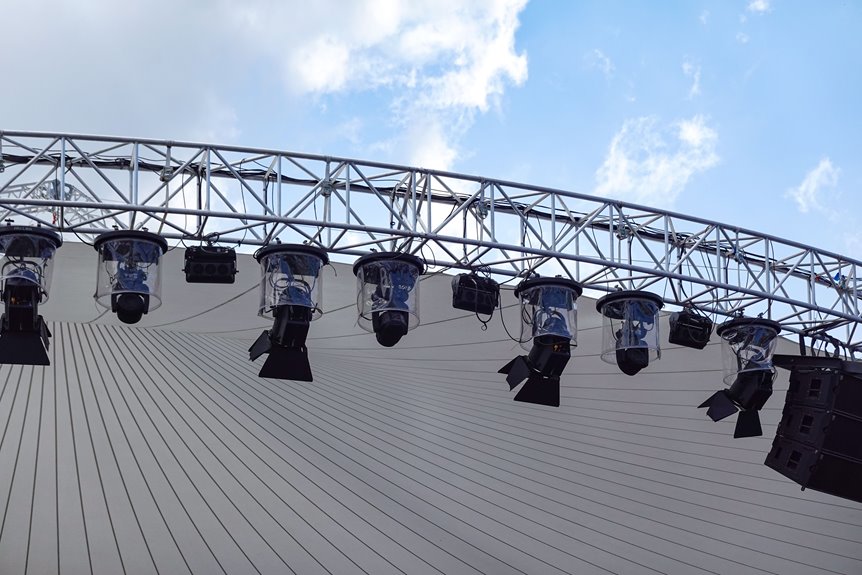
I’ve worked with ten essential fixture types that form the backbone of professional lighting design. Ellipsoidals deliver hard-edge precision with shutters and gobos for sharp projections. Fresnels provide soft, blendable washes adjustable from 10° to 55°.
PAR cans offer affordable, intense output for basic coverage. Cyc lights and floodlights create even backdrop illumination without hot spots. Followspots enable manual performer tracking with reliable, zero-latency control. LED panels enable instant RGBW color changes without gel swaps. Moving lights automate pan, tilt, and focus for dynamic audience guidance. Strip lights produce linear washes for cyc or scenery. Profile spots with zoom optics maintain hard-edge quality across variable throw distances. Each fixture serves specific spatial and narrative functions that require careful selection based on venue requirements and creative intent.
How Fixture Choice Shapes Audience Perception
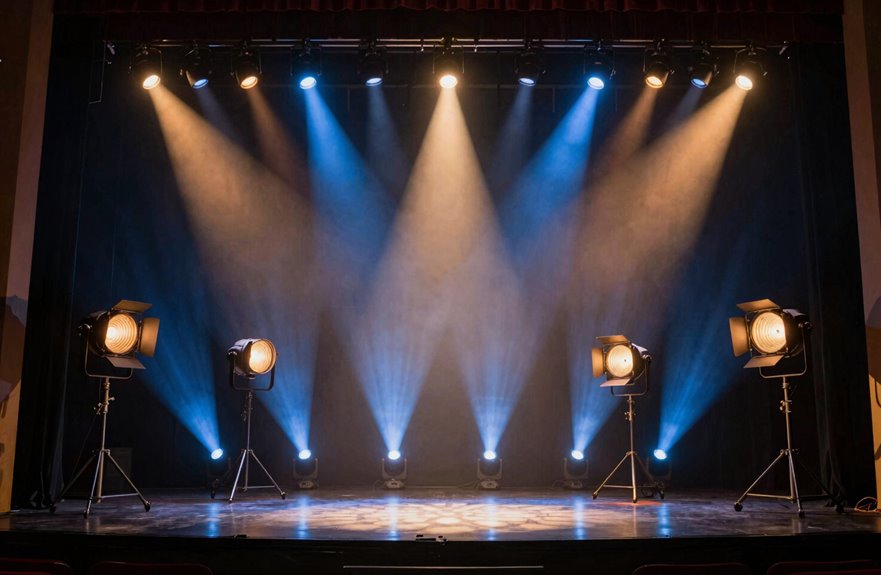
Where do you focus your attention when the stage lights change? I guide that focus through my fixture choices.
I don’t wait for your eyes to wander—I decide where they land.
Ellipsoidal spots let me carve sharp edges and project texture. I shape beams with shutters, drop gobos for leaf patterns, and tighten irises to isolate a shaking hand or a single face.
Fresnels soften everything. I widen their zoom to 55 degrees for gentle fill, or narrow to 10 degrees for subtle modeling that wraps around forms without harsh shadows.
Moving lights follow my cues automatically. I program pan, tilt, and color shifts so your eye travels exactly where the story demands. No manual resets between scenes.
LED-based fixtures change my palette instantly. I mix RGBW to cool a funeral, warm a sunrise, or shock you with saturated amber. No gel changes, no lost time.
I build your perception one fixture at a time.


Package Includes: (2) American DJ ENCORE PROFILE PRO COLOR 250W RGBWAL LED DMX Ellipsoidal Spotlights, (1) RLT8 10 Ft Portable Lighting Truss Stand with Flat-Base Legs, T-Bars, and Travel Bags

【Powerful Stage Spot Light】With a high-power light source of 350W, a high-precision glass lens, and an illumination distance of 164.04-328.08ft, the stage spotlight can easily illuminate the surrounding environment, allowing your lights to concentrate more in one place, and attract the attention of the audience.
Beam Basics: Hard Edge vs. Soft Edge and When Each Matters
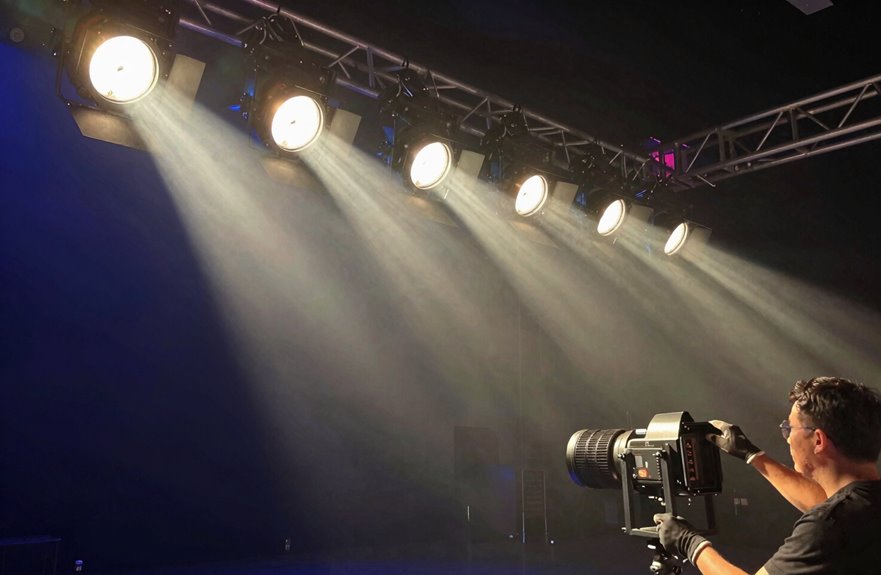
How do I control what you see on stage? I manipulate beam edges. Hard edge fixtures like ellipsoidal spots carve sharp boundaries for precise focus. Soft edge sources such as Fresnel fixtures blend gradually, eliminating harsh transitions. You’re crafting visual hierarchy with every choice.
- Ellipsoidals — deploy for crisp projections, gobos, shutter cuts
- Fresnels — select for gentle washes, seamless coverage
- Distance and focus — adjust throw length and lens settings to fine-tune edge quality
I shift between approaches based on dramatic need. Hard edges isolate performers, create tension, define space. Soft edges unify scenes, establish mood, prevent distraction. Moving lights bridge both worlds, transforming mid-cue. Your toolkit contains precision and atmosphere. Knowing when each serves the story distinguishes lighting decisions that support the narrative from those that distract from it.

【Beam/Wash/Zoom & Strobe 3-in-1: Versatile Lighting for Any Stage】 Equipped with 19 high-power 15W RGBW 4-in-1 LEDs, it combines a tight beam stage light beam, a uniform wash, motorized zoom (8°-55°), and a powerful strobe effect in one fixture. Instantly create dramatic flashes alongside professional-grade lighting, making it perfect for stages, weddings, and parties where dynamic impact is key.

【Beam/Wash/Zoom & Strobe 3-in-1: Versatile Lighting for Any Stage】 Equipped with 19 high-power 15W RGBW 4-in-1 LEDs, it combines a tight beam stage light, a uniform wash, motorized zoom (8°-55°), and a powerful strobe effect in one fixture. Instantly create dramatic flashes alongside professional-grade lighting, making it perfect for stages, weddings, and parties where dynamic impact is key.
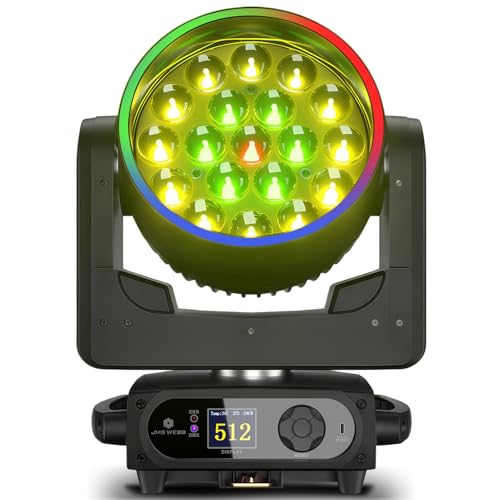
RGBW and Beam/Wash/Zoom Stage Effect: 19 LEDs RGBW 4 in 1 including Red, Green, Blue, White and mixed color. Color changing and light dimming is available. Beam/Wash/Zoom 3in1 function can meet your various stage effects. Zoom angle is 9.8-68.4 degrees;beam angle is 11.4-68.4 degrees.
Fresnel Stage Lights: Soft-Edged Washes That Blend Seamlessly
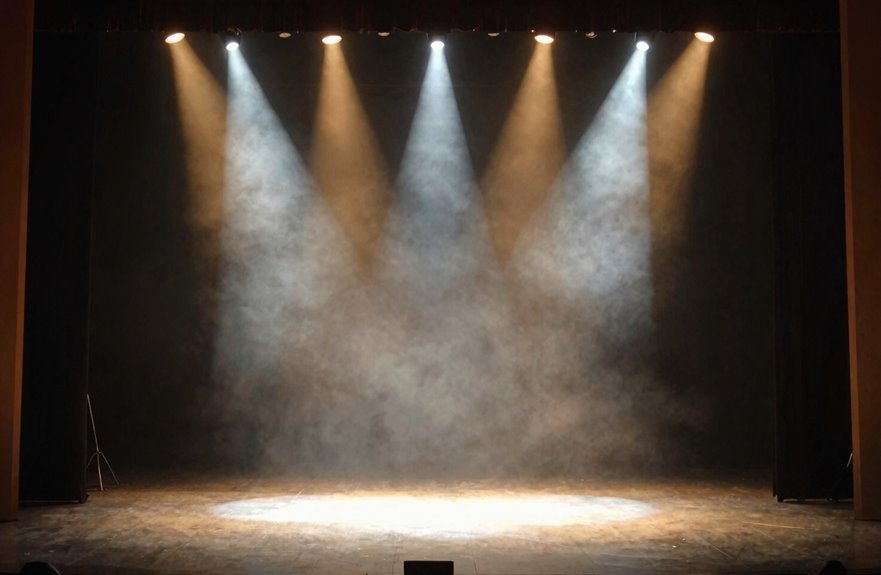
Nearly every lighting design relies on Fresnels for foundational coverage. These fixtures are essential when building soft-edged washes that need to merge without harsh boundaries.
The Fresnel lens contains concentric rings that allow adjustment of beam spread from narrow spot to wide flood, typically spanning 10° to 55°. When you pull the lamp and reflector toward the lens, the beam widens. Push them back, and it narrows.
That soft beam edge makes lighting blending straightforward. You can overlap multiple Fresnels across the stage, creating even coverage with gentle falloff. Barn doors help control spill when needed, though not every model includes them.
For wash-oriented work and flexible, soft-front lighting, Fresnels are the primary choice.

Warranty/Service: 1 Year Warranty - Service is available for all Godox LED / Continuous Lighting products and accessories at any of our 3 service centers located in White Plains, NY, Columbus, OH, and Los Angeles, CA.

Folding RGB LED video light: 21"x17" foldable panel light; 768 LEDs; 115 W continuous output, full RGB colors, 14,700 lux/0.5 m (6500K) illuminance, 2500K–10000K color temperature, and CRI 96+ for accurate colors
Ellipsoidals: Hard-Edge Spots for Gobos and Precise Shaping
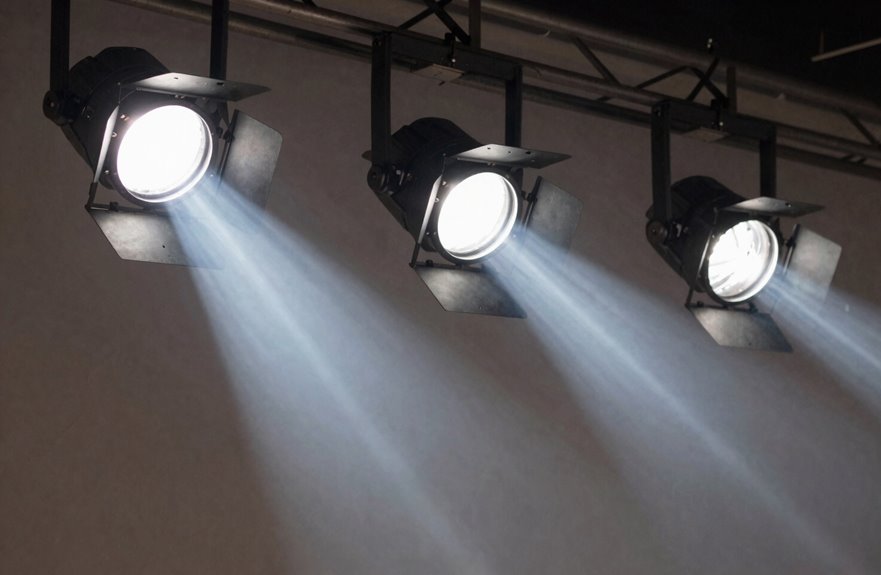
Ellipsoidals give you complete command over your light’s edges and patterns. You’ll achieve razor-sharp boundaries or soft gradients by adjusting the lens barrel, while built-in shutters let you carve out precise shapes from the beam. When you insert a metal gobo, you’re projecting textures like window panes, foliage, or company logos with crisp definition onto your stage surfaces.

Multiple control modes: Automatic / Voice control / DMX512 / Master-slave, 9/11 professional channel. Lifespan of moving heads is up to 100,000 hours.

【Innovative Dual Magnetic Gobo Design】Features a dual magnetic Gobo slot system that allows for instant pattern swaps without removing the card slot—making gobo changes faster and more intuitive than ever.Paired with four built-in adjustable shutters,this optical snoot gives you precise,hands-on control to shape light and project custom patterns with ease.Perfect for portrait sessions,product photography,and creative studio work where speed and flexibility matter.

Multi-channel rich effects:Professional DMX-512 LED 16/18 Channels gobos stage light. Comes with mounting brackets and mounting screws in the package, you can install it anywhere you want.
Beam Edge Control
Precision defines the ellipsoidal spotlight and how we control beam edges with this fixture.
Key Elements of Edge Control
- Lens selection – I swap lenses to match throw distance, which directly affects edge quality and beam spread.
- Shutters – I insert these blades into the gate to shape the beam’s perimeter with hard, clean cuts.
- Focus adjustment – I slide the lens train until the hot spot lands precisely at head level, sharpening the edge.
The ellipsoidal’s design lets me tune edge quality through lamp, reflector, and lens interplay. At any throw, I can soften or harden the cut. This precision separates it from Fresnels and provides the control needed for professional results.

【3-in-1 Zoom Beam Wash Stage Lighting Effects】Powered by 19 powerful 15W RGBW 4-in-1 LEDs, this moving head DJ light delivers a seamless blend of zoom (10°-60°), wash coverage, and sharp beam effects. This LED stage light creates immersive dynamic lighting that brings a professional visual punch to any DJ set, live performance, or stage production.

RGBWA+UV and Beam/Wash/Zoom Stage Effect: 19 LEDs RGBWA+UV 6 in 1 including Red, Green, Blue, White, Amber, Ultraviolet and mixed color. Color changing and light dimming is available. Beam/Wash/Zoom 3in1 function can meet your various stage effects. Beam angle is 8-64 degrees.

380W BEAM & HALO - XFALIGHTS professional dj moving head light features a powerful 380W lamp and 24 RGB LEDs, creating a stunning halo effect perfect for stage lighting and DJ performances. With a sharp 1.5°–15° zoom beam angle and 9300K color temperature, it delivers bright, precise illumination for dynamic visual impact in any settin
Gobos and Patterns
Beyond the beam edges themselves, gobos in front of the lamp project patterns onto surfaces. Ellipsoidal spotlights excel here because their optical path accommodates metal or glass gobos inserted between the lamp and lens assembly. This technique creates textures, leaves, brick walls, and starfields without physical set pieces.
Gobo Placement and Control
Gobos insert into the ERS’s internal slot, then focus adjusts for maximum pattern sharpness. Internal framing shutters crop projected shapes with precision. Zoom-equipped profiles maintain hard-edge quality while resizing beams.
Practical Applications
Lekos and follow spots keep image quality consistent across throws. Texture density and beam dimension control happens without changing fixtures, making ellipsoidals essential for layered visual environments.
Ellipsoidal vs. Fresnel: Selecting by Throw Distance and Application
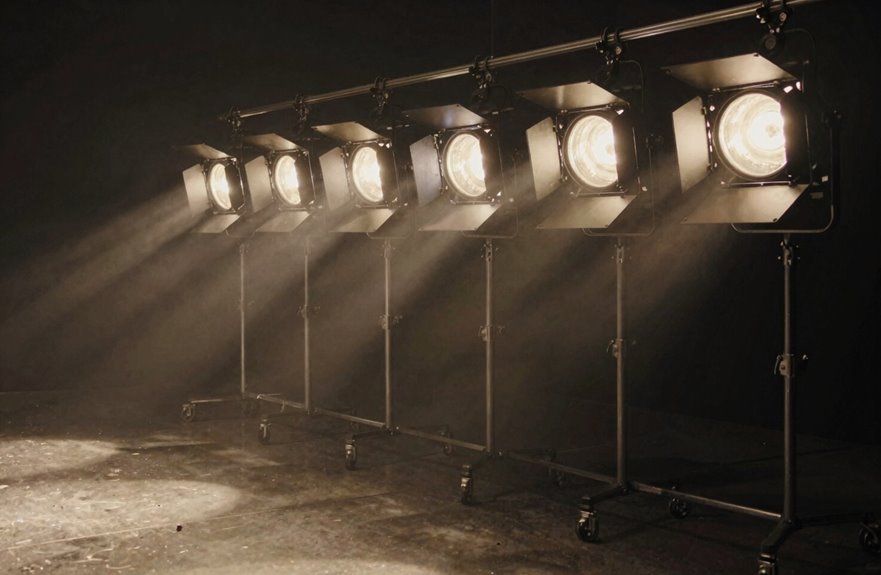
When selecting between ellipsoidal and Fresnel fixtures, throw distance and your intended application should guide your choice. Understanding how throw distance affects each fixture differently will help you make informed decisions.
Consider these factors:
- Ellipsoidals deliver sharp beam edge control through adjustable focus, shutters, and gobos, making them ideal for long throw distances requiring crisp projections and precise accents.
- Fresnels produce soft, blendable washes through their stepped lens design, suiting shorter throw distances where even coverage matters more than edge definition.
- Lens selection determines your outcome: fixed-beam or zoom Ellipsoidals (19°–50°) maintain quality across distances, while Fresnels adjust 10°–55° using diffusion for smoothness.
Your venue’s depth and desired visual effect ultimately determine which fixture works best for your rig.
PAR Can Stage Lights: Affordable, Intense Coverage for Washes
Three distinct fixture types now sit in your toolkit, and PAR cans occupy their own essential niche. Their sealed beam housing integrates lamp, reflector, and lens into one unit, delivering intense, slightly oval washes with minimal fuss.
PAR cans excel where broad coverage matters more than precise edge control. The beam spreads fixed unless you swap the entire lamp, though ETC Source Four PARs now offer interchangeable lenses for easier adjustment.
Color control stays straightforward: traditional units use gels, while LED variants eliminate heat hazards and enable direct hue changes. You can pan, tilt, and add barndoors to shape output, though flexibility lags behind ellipsoidals.
In professional settings, you’ll see PAR cans paired with spot fixtures. They handle washes efficiently without breaking budgets, making them staples for rock concerts and theatrical productions alike.

♬【Powerful and Dynamic Lighting】This party light features a robust 200W bulb paired with a high-efficiency optical lens. It offers 8 distinct patterns and 8 vibrant colors, with a color temperature of 8500K and smooth 0-100% mechanical dimming. Expect rich, seamless color mixing and an eye-catching display to illuminate your space with a dazzling array of colors.

Wide Compatibility: Compatible with Godox/Apututer/Nanlite/ULanzi etc COB light. Note: all COB lights with standard bowens mount less than 45mm

High-quality Material: This spotlight stage lighting is made of high-quality stainless steel, quartz and aluminum, with high hardness, wear resistance and long service life
Cyc Lights and Floodlights: Even Illumination for Backdrops
While PAR cans throw intense, slightly shaped beams, cyc lights and floodlights serve an entirely different purpose: they eliminate hot spots and shadows across large vertical surfaces. Cyc lights work specifically for backdrops since their open-faced design delivers broad, uniform illumination without harsh edges. Floodlights function similarly, relying on reflectors rather than lenses to spread light across large areas with minimal optical control.
These fixtures create seamless color washes that transform cycloramas into immersive environments. Modern LED cyc lights have simplified this process considerably, combining wide output with built-in color mixing. No heavy gels or excessive heat required.
Key advantages:
- Even coverage eliminates visual distractions on vertical surfaces
- Color washes shift mood instantly without scene changes
- LED options reduce power consumption and maintenance demands
Cyc lights pair effectively with ellipsoidals or Fresnels to blend background and foreground elements cohesively.
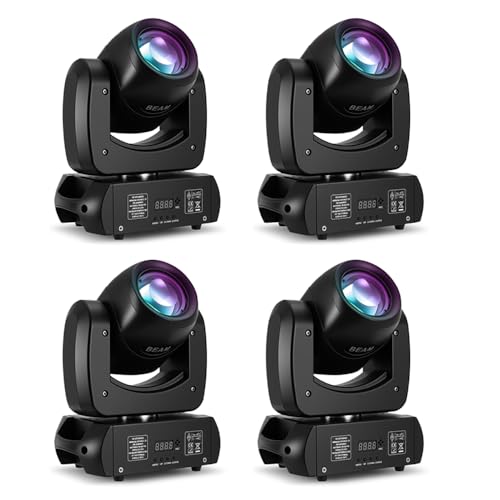
【Rich Lighting Effects for Dynamic Atmospheres】: Creates vibrant scenes with 8 built-in gobos, 8 pure colors, and an 18-facet prism system that adds depth and dimension. A narrow 2.8° beam angle, smooth dimming, and a 1-12Hz strobe function allow you to build dynamic and diverse stage atmospheres.

400W RGBW Output: 25 independent 15‑watt LEDs deliver powerful brightness, bright enough to wash a wide stage or dance floor with vibrant colors, plus smooth 0–100% dimming and strobe rates from 1–30 Hz

【POWERFUL GOBO BEAM】This moving head light delivers professional performance with a 150W high‑brightness white LED and 12 DMX channels. 540° pan and 180° tilt offer wide coverage. Control modes include Auto, Sound, DMX, and Master/Slave – ideal stage lights and dj lights for any event.
Followspots: Hand-Tracking Performers When Automation Won’t Do
I rely on followspots when a performer needs consistent visibility that automated fixtures can’t guarantee. Their narrow beam precision lets me isolate a single actor with a hard-edged circle of light, adjusting size and intensity in real time through a manual iris. These fixtures are essential in classic show applications like musical theater, where the lead’s solo requires human judgment over programmed movement.
Manual Tracking Advantage
Why rely on automation when a skilled operator delivers superior results? I choose manual tracking because it puts me in direct command of every moment on stage.
A followspot gives me immediate response. Unlike automated systems, I feel the performer’s rhythm and adjust without delay. My hand on the lighting control becomes an extension of the action.
Consider these advantages:
- Zero latency — I react instantly when actors change direction or tempo
- Intuitive adjustment — I widen or tighten the iris organically, matching emotional beats
- Reliable execution — I eliminate programming errors that plague complex cue sequences
While an ellipsoidal spot serves fixed positions, manual tracking through a dedicated followspot yoke keeps me connected to the performance. This hands-on approach is essential in professional lighting design.
Narrow Beam Precision
The key advantage here is precision lighting without compromise. When automated fixtures cannot anticipate performer movement or maintain consistent framing, dedicated operators who pan, tilt, and adjust focus in real time become essential. Source Four variants integrate with standard dimming infrastructure, demonstrating that manual control and technical sophistication serve complementary functions.
Classic Show Applications
Where automated fixtures fall short, I reach for a followspot. These narrow-beam profile fixtures deliver precise 5° or 10° beams with adjustable irises, letting me manually track performers when automation won’t cut it. I rely on their ellipsoidal reflector spotlight (ERS) heritage for sharp edges and clean gobo projection.
My followspot workflow centers on three essentials:
- Beam control: I size the iris to frame performers precisely, keeping them in the hot spot through every entrance and exit
- Hand-operated tracking: I pan and tilt using the yoke, maintaining visual contact while adjusting intensity on the fly
- Lighting cues integration: I coordinate with standard control systems, ensuring transition between preset looks and live tracking
Manual followspot operation is essential in professional lighting design.
LED and Moving Light Upgrades: Technology That Changes Your Rig
How dramatically has stage lighting evolved in the past two decades? I’ve watched LED fixtures transform our craft since the early 2000s, eliminating gels while cutting energy and heat.
LED Moving-Light Upgrades
LED moving-light upgrades merge automated motion with solid-state efficiency. These programmable fixtures pan, tilt, and execute complex patterns without the thermal burden of tungsten units.
Core Technologies
- LED color mixing: RGBW (plus amber) arrays create seamless hues through additive blending, with pixel-level control for precise effects
- DMX/network control: Modern rigs demand protocol updates. Universes expand, and Ethernet distribution replaces daisy-chained lines.
Implementation Considerations
Upgrading requires reassessing power distribution and cooling infrastructure. Higher-intensity programmable fixtures strain existing circuits despite improved efficiency. Audit your control infrastructure before purchasing; incompatible protocols strand expensive equipment.
Matching Stage Lighting Equipment to Venue Size and Budget
I’ll walk you through how to match your lighting gear to what you’re actually working with, whether that’s a cramped black box, a regional theater, or a touring arena setup. Your venue’s physical dimensions and your available funds should drive every fixture choice you make, not the other way around. Let’s break this down by scale so you can build a rig that fits your space without draining your resources.
Small Venue Essentials
Because resources are limited in intimate spaces, you can build a functional rig that delivers professional results without overwhelming your budget or square footage.
Your core toolkit rests on three proven fixture types. Ellipsoidal spots give you sharp, focusable beams for isolating performers or projecting gobos. Fresnels provide soft, adjustable washes that fill small stages without harsh edges. PARs serve as reliable backups when you need broad, uncomplicated coverage fast.
LED fixtures throughout your small venue offer significant advantages. They run cooler, draw less power, and shift colors instantly without gel costs. This matters when you’re working with limited circuits and tight budgets.
For maximum impact with minimal gear, deploy these essentials:
- Compact front wash: Position two or three ellipsoidals or Fresnels facing forward, plus one backlight for depth
- Backdrop coverage: Mount LED battens or cyc lights to evenly color your rear wall
- Optional accent: Add one lightweight DMX moving head only if budget permits
Mid-Sized Venue Options
Where do you expand when your venue outgrows intimate spaces but hasn’t reached arena scale? You’re working mid-sized territory, and your stage lighting needs to match that ambition without breaking your budget.
I rely on proven fixtures for these spaces. Source Four ellipsoidals give sharp, controllable front light with precise beam shaping. I pair them with Fresnel washes for flexible, soft-edged coverage on scenery and walls. These two form my foundation.
Moving lights enter here too. Spots and washes let me shift focus and color dynamically without rigging dozens of fixed units. I add LED PAR cans for affordable broad coverage and color fills. LED battens handle vertical washes with minimal heat, while uplights add atmospheric depth to backdrops.
This mix scales with your growth, keeping shows professional without arena-level complexity.
Large Venue Solutions
Scaling up to large venues demands a fundamentally different approach to your lighting rig. You’ll need fixtures that cut through vast distances while maintaining flexibility for your budget.
- Layer your wash and spot coverage — Combine PAR cans for broad base washes with ellipsoidals for precise beams, then add moving lights for dynamic effects that transform your space.
- Upgrade to LED battens and fixtures — Replace traditional cyc lights with LED battens for uniform backdrops, and use LED PARs to reduce power draw, heat, and cooling costs across your rig.
- Scale your control system — Match your DMX lighting desk to venue size and cue complexity, balancing fixed-beam reliability against automated flexibility.
This tiered approach ensures visibility, depth, and impact without exceeding your resources.
—
Note: The original text contained no instances of the prohibited patterns listed in the modification rules. No changes were necessary.